

Purified Water – The new Chinese Pharmacopoeias and What Happens Next?
5 min. reading time | by Fritz Röder
Published in LOGFILE 01/2026
A new Chinese Pharmacopoeia was published in 2025. This has had some significant implications for the pharmaceutical water industry, which we will discuss in more detail in this article. Firstly, it is important to note that cold WFI systems are now permitted worldwide and can be used across the board.
History
The distillation of water for injection (WFI) was prescribed as early as the beginning of the 19th century. The image below shows an example of a chapter from the 1880 American USP VI.
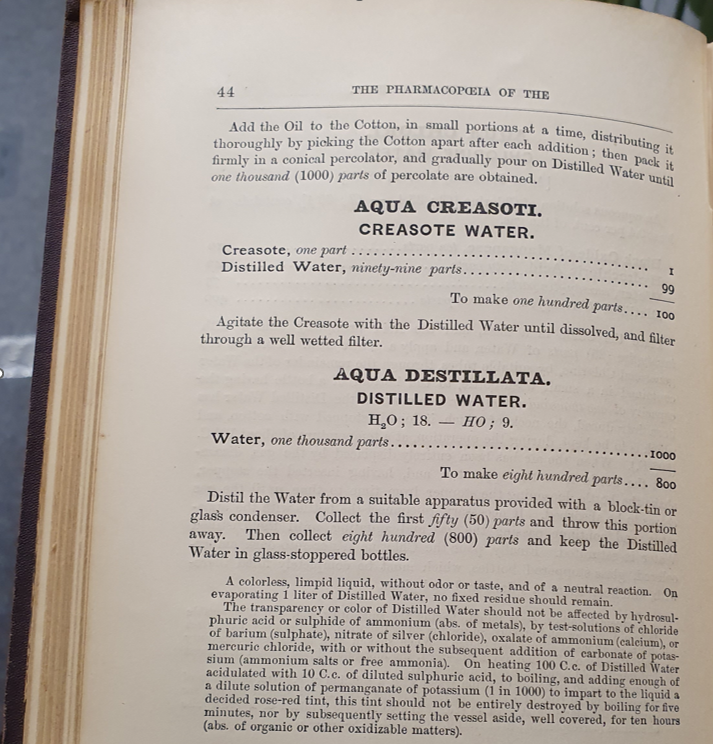
Fig. 1 | Excerpt from USP VI from 1880
Pharmaceutical water is unique: no other monograph in the pharmacopoeias of any country contains specifications on how a substance is to be manufactured. Only test methods are described. In the USA, distillation was removed from pharmacopoeias over 50 years ago. However, as many pharmaceutical companies have international customers, they still must comply with other pharmacopoeias. The European Pharmacopoeia and those of other countries continue to require distillation for WFI production. Consequent-ly, membrane technology has yet to become established in the American market. Additionally, WFI systems in American companies are often centrally planned and therefore very large. This has allowed thermocompression to become a widely used manufacturing method. This has not been the case in Europe, where there has traditionally been a greater focus on decentralised systems. Small thermocompression plants quickly become uneconomical and are therefore rather rare.
Following a debate within the EDQM that lasted around 25 years, membrane technology was finally approved to produce WFI in Europe in 2017. While the publication of the new pharmacopoeia in 2017 initially allowed all parties to breathe a sigh of relief, distillation remained mandatory in China, the last country in the world to do so. To continue serving this market, many companies opted to continue distilling WFI.
Representatives of the Chinese Pharmacopoeia attended the discussions and were there-fore aware of the risks associated with membrane technology. However, a consensus had to be reached first. Since the Chinese Pharmacopoeia is only updated every five years (with the exception of supplements), it was not permitted until 2025.
The new chapters
The 2025 edition of the Chinese Pharmacopoeia is currently only available in Chinese. An official English translation is in progress. Industry representatives are acting in an advisory capacity. The translation is expected to be as faithful to the original Chinese text as possible. However, based on unofficial texts, it is already clear that the new chapters are very easy to read and that international scientific terminology has been adopted wherever possible. The terminology relating to 'pharmaceutical water' is well harmonised. Therefore, the chapters can be easily compared with their European and American counterparts.
Below is an overview of the existing chapters. The most important ones are in bold and explained below. Chapter 9209 has been completely rewritten and is an 'informative, non-binding' chapter, similar to Chapter 5 in the Ph. Eur. or USP Chapters <1000> and above.
- 0251 General Requirements for Pharmaceutical Excipients
- 0261 Water for Pharmaceutical Purposes
- 0681 Conductivity Determination of Pharmaceutical Water
- 0682 Determination of Total Organic Carbon in Water for Pharmaceutical Use
- 0862 Elemental Impurities
- 1105 Microbiological Examination of Nonsterile Products: Microbial Enumeration Tests
- 9209 Guiding principles for microbial monitoring and control of pharmaceutical water (informativ, nicht bindend)
- Monographs for
- Purified Water
- Water for Injection
- Sterile Water for Injection
The most important information is that the production of cold WFI is now permitted in China.
Excerpt from a preliminary translation of Chapter 0261:
Water for injection is water prepared by distillation of purified water. The quality of water for injection complies with the provisions of Annex 2 to this general chapter for water for injection; Or may be prepared by a purification process equivalent to distillation, and the preparation process shall meet the relevant requirements of the regu-latory authorities and its quality shall meet the relevant provisions. It is a clear, colorless liquid. It contains no additives.
The question arises as to whether distillation plants must continue to use 'purified water' as feed water according to the pharmacopoeia. However, this remains unclear as upper- and lower-case letters do not exist in Chinese usage. The following additional paragraph can be found in the same chapter:
Excerpt from a preliminary translation of Chapter 0261:
The source water used for purified water, water for injection and sterile water for injection is usually drinking water.
It is clear, therefore, that there are still some minor ambiguities in the texts, but the overall direction is evident.
The drafts initially contained a requirement for the hot storage of WFI (minimum 70 °C), but fortunately this has been omitted from the final chapter. Storage at room temperature using ozone is therefore permitted. The Chinese GMP Guide merely describes permission to store the water hot.
Another significant change in the water chapters can be found in the individual monographs, i.e. the test specifications for WFI. Specifically, this concerns wet chemical tests. The good news is that 99% of routine testing using wet chemical methods can now be omitted. The (unofficially translated) texts from the WFI monograph state the following:
Excerpt from a preliminary translation from the WFI monograph:
If it is determined by the determination of water for injection in the determination of pharmaceutical water conductivity method (General rule 0681), the conductivity is determined by the first step of the determination method to meet the requirements, that is, the conductivity meets the requirements, and the pH, heavy metals, nitrates, nitrites and ammonia can no longer be carried out.
If measured by the determination of water for injection in the determination of pharmaceutical water conductivity method (General Rule 0681), the electrical conduc-tivity is determined by the first step of the determination method and does not meet the requirements, but by the second or third step of the determination method, that is, the electrical conductivity meets the requirements, and the pH and heavy metal inspection can no longer be carried out.
In essence, if the conductivity measurement specifications (1.1 µS/cm at 20 °C) are met in the first stage of the test, there is no need to test for pH, heavy metals, nitrate, nitrite or ammonium. This is always the case in routine testing anyway, as online conductivity meters only use the first stage of the method. If the conductivity requirements are only met in the second stage of the method (dissolving CO₂ in the sample), then testing for pH and heavy metals can be omitted. If the conductivity requirements are not met at all, an OOS result will be obtained anyway, and, in principle, testing of the other parameters can also be omitted, provided that the OOS result is not invalidated.
Overall, however, this is very positive news, as it will save work for pharmaceutical laboratories worldwide. Incidentally, these simplifications also apply to purified water. In this case, however, the conductivity requirements for WFI must also be met.
Finally, we would like to draw your attention to the extensively updated Chapter 9209, 'Guidelines for the Monitoring and Control of Microorganisms in Water for Pharmaceutical Purposes', of the Chinese Pharmacopoeia. Despite its non-binding nature, it contains some interesting information, particularly regarding monitoring and control strategies. For instance, it recommends that drug manufacturers conduct studies to evaluate the effectiveness of different incubation conditions. The culture medium and conditions with the highest recovery rate 'win the race'. Such concepts can also be found in USP <1231>, but not in the European Pharmacopoeia. Here, the test method is strictly specified (culture medium R2A). This 'standard approach' can also be found in the binding chapters of the Chinese monographs.
Another section that attracts attention describes a concept for monitoring WFI. If the monitoring only observes results of '0 CFU/100 ml', the concept provides for the filtration volume to be increased during incubation (i.e. more than 100 ml is filtered) to obtain results greater than '0 CFU/100 ml' again. However, many companies set alarm limits at 1 CFU/100 ml for WFI as part of their routine, triggering species testing to identify the flora in the system. Increasing the filtration volume in routine monitoring would therefore lead to repeated warning limit exceedances, and ultimately, action limit exceedances. Such increased filtration volumes are therefore only recommended as a 'study'.
Overall, the new Chinese chapters are to be commended, as pharmaceutical manufacturers are now permitted to produce cold WFI with minimal additional requirements. In addition, the new monographs incorporate well-harmonised, streamlined test methods, especially the elimination of wet chemical methods, which is to be welcomed and should make the work of quality control laboratories around the world somewhat easier.
Do you have any questions or suggestions? Please contact us at: redaktion@gmp-verlag.de

You may also be interested in the following articles:


