
Personnel Hygiene is not a Delicate Matter! – What are Hygiene Programmes for?
5 min. reading time | by Thomas Peither
Published in LOGFILE 41/2023
‘Hygiene programmes adapted to the activities to be carried out shall be established and observed. These programmes shall, in particular, include procedures relating to health, hygiene practice and clothing of personnel.‘ This is explicitly stated in the EU GMP Directive 2017/1572.
The same or similar requirements can also be found in the EU GMP Guide and in 21 CFR 211. For personnel hygiene, this means: Just as hygiene plans are expected for premises, detailed hygiene programmes must also be established for personnel. Management must actively support this, provide the necessary resources for training and create the framework conditions for hygienic behaviour in the company.
What is the purpose of hygiene programmes?
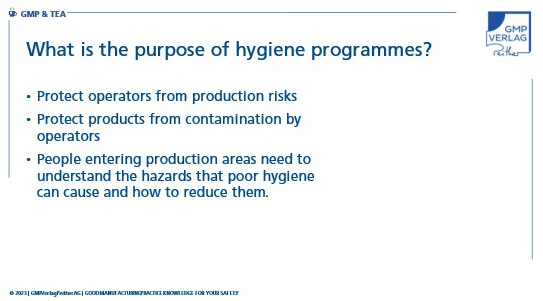
Hygiene programmes are designed both to protect the health of operators from production-related hazards and to protect manufactured products from contamination by employees.
Both aspects are equally important. Product and operators – one must be protected from the other and vice versa.
Although the regulations primarily address personnel screening, clothing and workplace behaviour, a hygiene programme should include all measures necessary to maintain and improve the health of personnel and to prevent and control disease.
The nature and scope of the programmes will depend on the nature of the activities and the environment, i.e. the requirements will correspond to the criticality of the manufacturing processes.
For companies with different product categories, there will therefore need to be risk-dependent and area-specific gradations in the hygiene programme, depending on what is being produced, for example whether it is a dermal, oral or parenteral product.
Every employee must be aware of the hazards of poor hygiene for the products and how they can reduce these hazards through their own behaviour. This also applies to visitors or external service providers who enter production areas.
This article is a shortened and translated excerpt from the 26th episode of our German GMP & TEA webcast.
Do you have any questions or suggestions? Please contact us at: redaktion@gmp-verlag.de

You may also be interested in the following articles:


