
New in Annex 1: the Contamination Control Strategy (CCS)
Excerpt of the GMP Compliance Adviser, Chapter 12.B
5 min. reading time | by Christoph Brewi and Florian Sieder, PhD
Published in LOGFILE 23/2023
“The new Annex 1 requires a comprehensive and overarching contamination control strategy (CCS). It records and links the different aspects and the associated accompanying measures, shows possible interactions and supports a corresponding analysis of any weaknesses or gaps in the system,“ explain Christoph Brewi and Florian Sieder in the GMP Compliance Adviser.
New to Annex 1 and already in the GMP Compliance Adviser! The excerpt from the unique GMP knowledge portal shows what is meant by a CCS and the benefits it offers.
What is meant by CCS?
The current Annex 1 (version of 22/08/2022) of the EU GMP Guide marks a paradigm shift in the rules and regulations of Good Manufacturing Practice (GMP).
The focus is on a more risk-based and holistic approach.
For the first time, a comprehensive and overarching contamination control strategy (CCS) is required. It records and links the different aspects and the associated accompanying measures, shows possible interactions and supports a corresponding analysis of any weaknesses or gaps in the system.
As a central element of Annex 1, the CCS should
- document a comprehensive approach in the manufacture of medicinal products. Organisational, technical and procedural control measures must be observed. They are to ensure comprehensive effectiveness.
- guarantee that all risks are identified, assessed according to a standard procedure and mitigated and eliminated in an appropriate manner.
Annex 1 expects the entirety of the measures for contamination control on the basis of a concept appropriate to the respective product and its manufacturing process with the necessary level of detail for e.g.:
- Avoidance of cross-contamination (product or cleaning residues)
- Sterility assurance
- Control of biological contaminants (microorganisms/bioburden, bacteria, pyrogens/endotoxins, fungi, yeasts, viruses, bacteriophages, mycoplasmas, prions (BSE/TSE))
- Control of foreign particles (non-viable, visible/sub-visible, intrinsic/extrinsic)
The CCS is thus intended to be a steering instrument for the rational handling of risks in the manufacture of medicinal products.
In Figure 1 you will find the definition of contamination control strategy from the glossary to Annex 1.
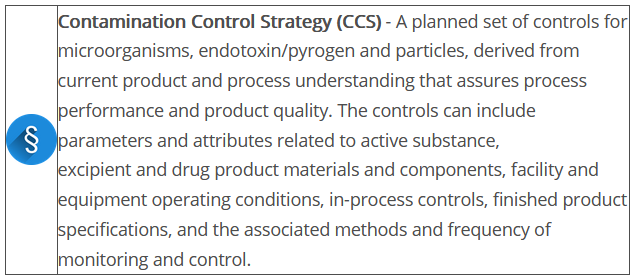
Figure 1 Definition of the contamination control strategy (Annex 1, Glossary)
What is the benefit of a CCS?
Responses to inspection and audit findings are not intended to be single and individual, but to address fundamental deficiencies or improvements in existing systems, processes or organisations. Regulatory authorities expect the root causes of GMP compliance failu-res to be identified and addressed accordingly.
These requirements for contamination control or quality risk management are already required in numerous regulations, such as the EU GMP Guide (Chap. 1, Chap. 3, Chap. 5, Annex 2, Annex 15).
In order to exclude recurring deficiencies and to support a continuous improvement process (CIP), attention must be paid to a holistic view of the issues in the response to deficiencies as well as in the implementation of necessary corrective and preventive actions. The function and benefit of a contamination control strategy should also be seen in this context.
How can we ensure that the CCS document is reliable and fit for purpose?
The creation of the CCS is to be understood as a comprehensive and overarching activity and not as a listing of existing documents. A central challenge lies in the necessary depth of detail to present the CCS – specific to the product, process and environmental condi-tions in each case – in sufficient, convincing and purposeful actions.
The CCS should
- include appropriate references to the relevant documents,
- for new installations ideally already be prepared in the design phase and included in the user requirements specification (URS) and the DQ documents.
What belongs to a CCS, how the contents are defined, how the CCS is created and how it is put into practice, you will learn in the brand new chapter 12.B of the GMP Compliance Adviser.
Do you have any questions or suggestions? Please contact us at: redaktion@gmp-verlag.de

You may also be interested in the following articles:


