

Insufficient cleaning validation
Shortened excerpt from Chapter 21.C.2.5 of the GMP Compliance Adviser
5 min. reading time | by Lea Joos
Published in LOGFILE 45/2020
The deficiency
During the cleaning validation, the PDE values of the active ingredients were determined in order to implement the EMA Guideline on setting health based exposure limits for use in risk identification in the manufacture of different medicinal products in shared facilities.
For a combination drug only the higher dosed active substance was considered, because the risk assessment assumed that the lower dosed active substance is no longer detectable when the higher dosed active substance is cleaned to an acceptable level. Neither the PDE nor the cleanability or solubility of the lower-dose active substance was included in this informal risk assessment. The previous worst-case substance was retained without further rationals.
- Furthermore, the following points were not comprehensible from the PDE reports:
- Extent or completeness of the literature search with indication of the data used
Selection criteria of the LOEL used for the calculation
(Ref.: EU GMP Guide Part I No. 5.21 and Annex 15 No. 10.6)
That was the problem
The shortcoming was twofold:
Firstly: Insufficient integration of PDE values in the worst-case concept of cleaning validation
In the present case, PDE had not been calculated for all active substances, because the company assumed that after the cleaning of active substance A up to its limit value of active substance B, "nothing is left", so that a PDE calculation for active substance B was not considered necessary by the company.
The assumption that an active substance is "no longer present" is fundamentally difficult: how many decimal places in which unit mean that "nothing" is no longer present?
A sample calculation is to illustrate this problem (see Figure 21.C-11 ):

Figure 21.C-11 Assumption of a comparable cleaning of active substance A and active substance B
Does 0.00625mg (or 6.25µg) mean that "nothing" is left?
I hope you would answer this: it depends. In fact, it depends on the potency/toxicity of the active ingredient B, i.e. the PDE value. And that brings us to the real problem: the assessment of whether a "no matter how low" value is low enough after purification can only be made by means of PDE – and that was missing in this case.
Furthermore, the company did not question whether the cleaning of active substance B is actually "equally good" and whether this conclusion by analogy is possible at all. For example, active substance A could be very soluble in water, whereas active substance B could be very poorly soluble – so that the two substances would show different behaviour during cleaning.
Irrespective of the various other PDE values for active substances C and D, active substance A, previously defined as the worst-case active substance, was still defined as the worst-case active substance. There was no evaluation of the continued validity of the classification as worst-case active substance based on the calculated PDE values for active substances A, C and D.
Second: Deficiencies in the PDE report
From the PDE report itself, it was not possible to identify which databases had actually been used for the literature search. It was therefore not possible to assess whether the literature search was carried out completely in accordance with the EMA guideline (see C.3.3.7 Guideline on setting health based exposure limits for use in risk identification in the manufacture of different medicinal products in shared facilities and 8.E.2.1 How to determine the PDE – principles of a risk assessment).
The PDE report derived the PDE value for active substance A from the LOEL (Lowest Observed Effect Level). However, the EMA-Guideline requires the derivation of the NO(A)EL first (see C.3.3.7 Guideline on setting health based exposure limits for use in risk identification in the manufacture of different medicinal products in shared facilities). If the NO(A)EL is not used or if several NO(A)ELs exist, it must be justified why which value is used for further calculation. This justification is missing.
To avoid this error
To the first part of the deficiency:
For the integration of PDE values in the cleaning validation, a concrete concept should exist which should be able to answer the following questions:
- For which substances must PDE reports be prepared? And for which not? What criteria are applied for this?
- Can different active substances be grouped together for the PDE report? What would be required for this?
- How is the PDE value included in the derivation of the worst-case (active) substance? Which criteria are included in addition to PDE? What is the weighting? Are there criteria which "always" must lead to consideration in the validation?
- Can PDEs/ADEs be transferred to medicinal products from a toxicological point of view in a non-drug context? Which (minimum) criteria must be met?
An approach for determining the worst-case product is presented in 8.D Establishing the scope of validation. Here, the selection criteria include, for example, active substance content, solubility and therapeutic dose. Other criteria that have also been used so far include cleanability and toxicity. Especially the point "toxicity" can now be very well substantiated with the result of the PDE report and should be taken into account accordingly in the selection of the worst-case product. The weighting of the various selection criteria must be risk-based, as shown in Figure 21.C-12 as an example.

Figure 21.C-12 Example of weighting of selection criteria for the worst-case substance
In this example, an evaluation from 1 to 4 is made with the following meaning:
- Active ingredient content: very low (1) to very high (4)
- Toxicity: very low (1) to very high(4)
- Solubility: very good (1) to very poor (4)
- Cleanability: very good (1) to very poor (4)
For the selection criteria, weighting is done by factors 1 to 3, and weighting the toxicity by a factor of 3 means that the respective toxicity value is multiplied by 3 in order to make the toxicity more relevant in the final evaluation.
Example:
- Without the weighting, the sum of the assessment factors for active substances A and B is 11 each;
- Taking into account the weighting factors, the final assessment factor for active substance A amounts to 25 and for active substance B to 21; the toxicity is thus more strongly reflected in the final evaluation.
For such an evaluation, it is necessary to group the PDE values, e.g. PDE 1-50µg/day to "toxicity high" (group 3). Such groupings may not adequately reflect the criticality of an active substance in individual cases. In such cases, the active substance must be considered as a worst-case active substance on the basis of a single criterion, e.g. PDE value or solubility alone.
It is very difficult to justify not having a PDE value calculated for individual active substances. This is because toxicity must be taken into account in addition to other criteria such as active substance content and cleanability. And how do you substantiate this – if not via the PDE value?
In addition perhaps a small excursion into the US-American area. In 21 CFR 211 you will find the sentence element scientifically justified in several places. Keep this keyword in mind, for example when excluding active ingredients from the PDE calculation.
No matter what you do – ask yourself beforehand:
Do I really have any scientific justification for this?!
For activities that you carry out according to SOPs or other instructions, such as manufacturing instructions, this scientific justification is usually given. However, as soon as you are in an area that goes beyond this, remember this question.
To the second part of the deficiency:
The company should formulate its own requirements for external toxicological reports that can be reviewed by "non-toxicologists". In principle, this is a matter of "logical" traceability of the toxicologist's information, especially in the following areas:
Type and scope of the literature search with indication of the databases
Criteria for deriving the most relevant NO(A)EL or justification for using a LO(A)EL
Criteria for deriving the correction factors for the PDE calculation
Then also non-toxicological staff can check the compliance with these criteria and exclude gross errors, e.g. with regard to literature research or comprehensible documentation.
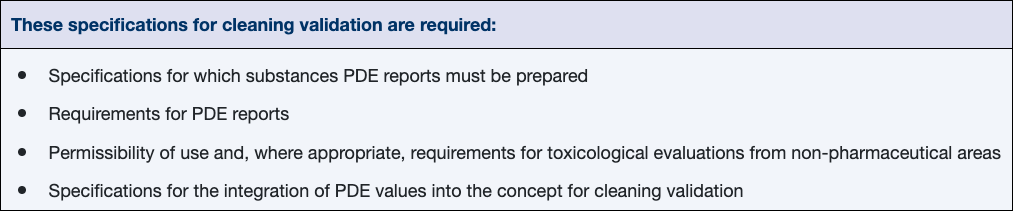
Figure 21.C-13 Important specifications for cleaning validation
Do you have any questions or suggestions? Please contact us at: redaktion@gmp-verlag.de

You may also be interested in the following articles:


