Skip to main content Skip to search Skip to main navigation

Innovations in Pharmaceutical Manufacturing

Conference Report: PDA Annual Meeting, March 15-17, 2021

8 min. reading time | by Thomas Peither
Published in LOGFILE 18/2021

Were you able to follow the PDA Annual Meeting of the Parenteral Drug Association this year? Or were you like many others who spent the whole day with web meetings and have no time or mood for more online conferences?

We attended the virtual PDA Annual Meeting 2021 and in the following I will give you a brief insight into a few presentations that we followed with a focus on GMP.

First of all, I would like to praise the organisation, because it was very helpful to be able to download the presentations before the event so that we could follow them better. It was also easier to formulate questions. The advantage of this approach was evident from the large number of questions and the interesting discussions.

I found the virtual city tour of New Orleans, the coffee breaks with inspiration, music and distraction very inspiring. Other organisers can learn from this!

As PDA President Richard Johnson confirmed, future Annual Meetings will be planned as hybrid events. And I would be happy if, for example, city tours would then also take place locally - but that's just by the by. 

President and CEO Richard Johnson, Jette Christensen and Susan Schniepp, conference chairs, opened the virtual PDA Annual Meeting.


Analytical Target Profile and Target Measurement Uncertainty

“ICH Q14 will establish a concept for an overarching analytical method development strategy,” so Robert Mayer from Novartis. Analytical Quality by Design (aQbD) stands for him for a structured method development approach, know-how transfer and a simplified science-based change management.

The analytical target profile (ATP) is a central document to start and support the life-cycle process. It is a prospective description of the desired method performance parameters. And it should be available for all highly critical quality attributes and is a basis for the method selection.

In his presentation, he also looks at the doubts and hindrances in establishing an ATP.
That is the reason that he focused on the TMU (target measurement uncertainty). Robert Mayer identified the TMU as a key tool for defining ATP requirements. Additional points in his presentation are method risk analysis, design of experiments (DoE), analytical control strategy, risk and change evaluation.

This was a good example of how innovative methods can push the industry into the future.


Improving Knowledge Transfer to Reduce Risk and Benefit Patients

Quality risk management and knowledge management are highly dependent. But in practice it isn’t integrated in the pharma industry at all. This was the presentation opener of Marty Lipa, Merck, for the talk with the title “Holding on to What You Know: Improving Knowledge Transfer to Reduce Risk and Benefit Patients”.
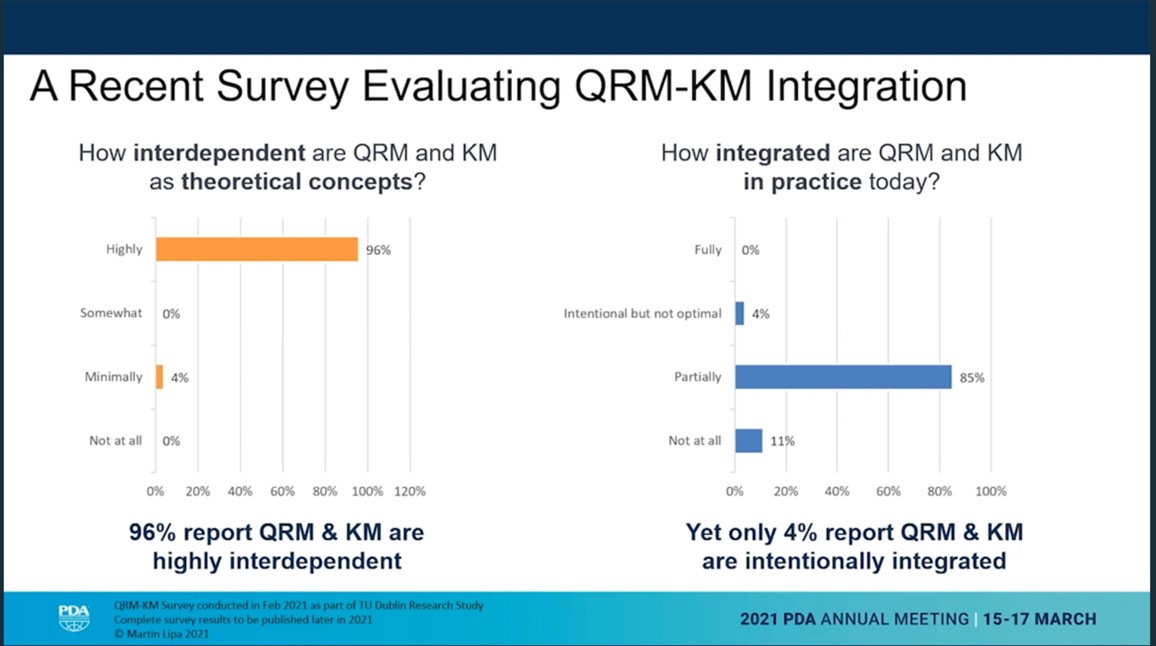
He described the concept of the continuous and perpetual “Risk-Knowledge Infinity Cycle”. Risk is decreasing as knowledge is increasing. Referencing ICH Q10 the risk-knowledge framework could be a solution, if adequately applied.

Marty Lipa described with some very good slides the knowledge transfer challenges, today. The first thing is the focus on minimum requirements to manufacture a batch successfully. But because of heavy documentation orientation, the tacit knowledge gets lost. Additionally, a lot of knowledge leakages in the development and or prior commercial manufacturing experience - a lot of knowledge gets lost.

With that experience, Marty Lipa introduced also an effectiveness toolkit and tested tools to gain tacit knowledge for transfer.


Automated Continued Process Verification

Experience Disruption & GMP live: Continued Process Verification (CPV) is the third stage of FDA process validation. It proves that a manufacturing process operates consistently and compliantly. For each product, regular reports must include statistics for multiple CQAs and CPPs, deviations, trends and explanations. These reports involve a lot of effort.

In his presentation, Ashwin Monian very clearly showed how Merck & Co responds to this effort with an automated solution. The title of his presentation was “Automated CPV Reporting: From Routine Compliance Exercise to State-of-the-Art Process Monitoring”.

Ashwin Monian reports on this groundbreaking project with great enthusiasm. Repetitive and manual tasks were automated and thus made obsolete. New database structures and proprietary software applications were developed. As a result, the basic structure of the corresponding reports can be created and sent for review within minutes.
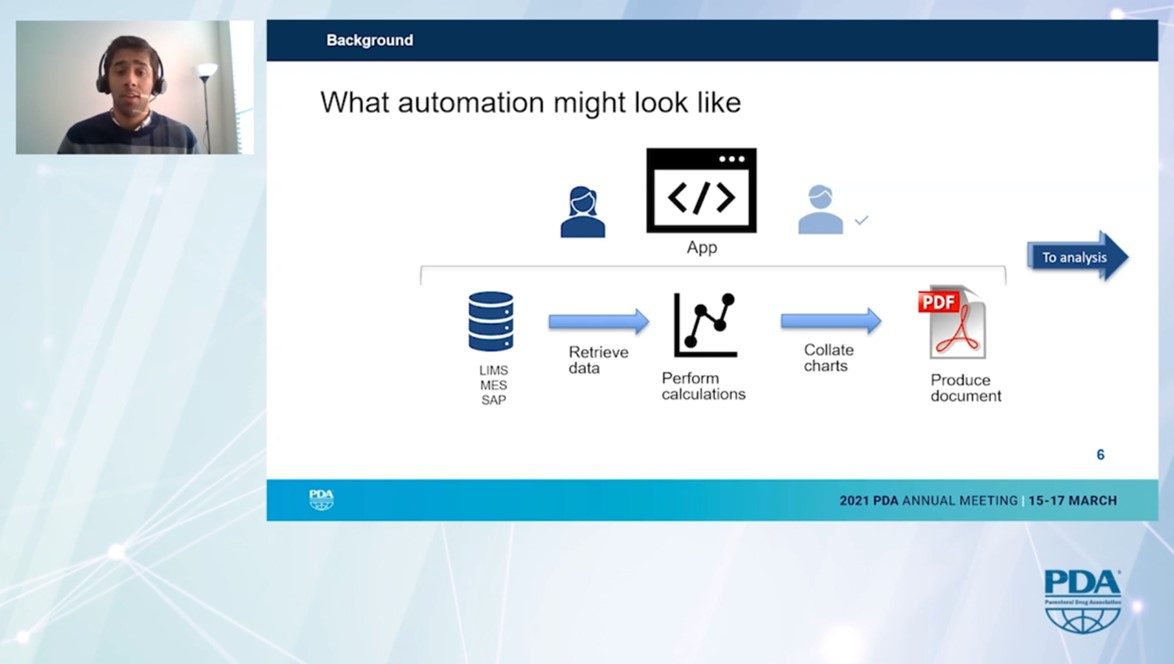
Automation significantly reduces the error rate and massively increases the efficiency of report generation - in the past it took several weeks, today only minutes.

The GMP-compliant, automated CPV software was developed in collaboration with Manufacturing Sciences and IT. It has been implemented at five sites and will be fully integrated across the Group by 2022.

This project is a beacon in the still often conservative pharmaceutical environment. We would like to see more presentations like this, which prove that disruptive approaches in a GMP-regulated environment are possible and worthwhile!


Organisation, Governance and Competency Development

Mauro Giusti, Eli Lilly Italia, gave an impressive presentation entitled: “Organisation, Governance and Competency Development for Successful Parenteral Manufacturing”.

The presentation of the support loops in the organisation was remarkable. He distinguishes between the “variability reduction loop” on the shop floor and team level, the “improvement loop” for the technical team and the “breakthrough loop” on the site level.
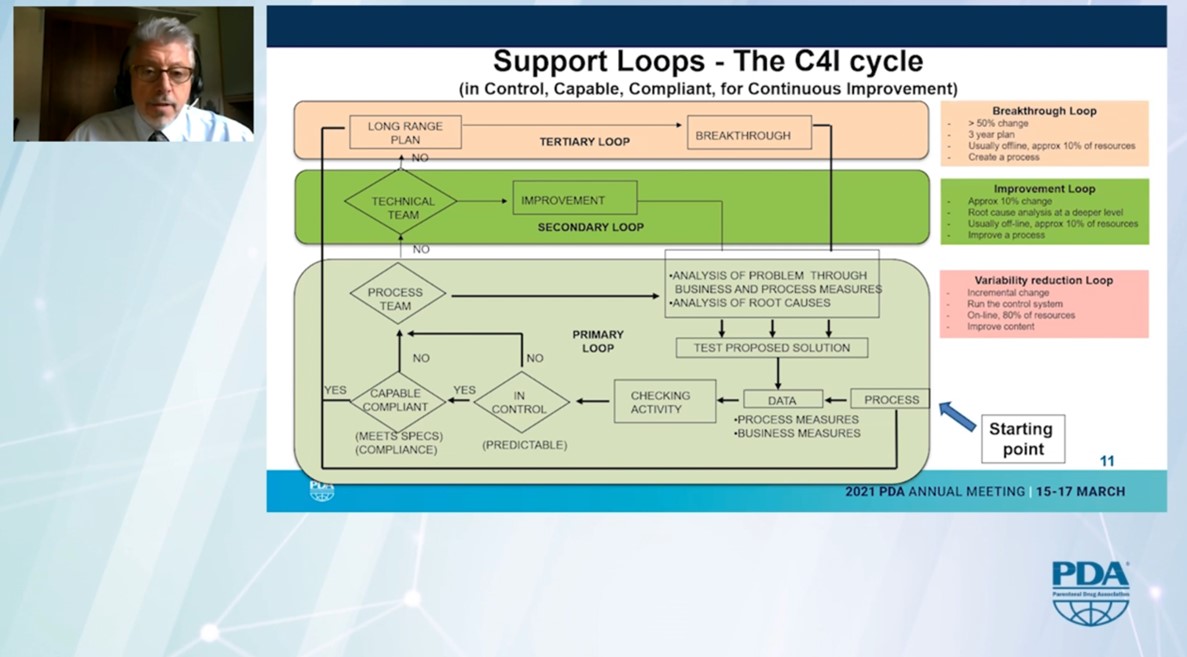
He thus presents a blueprint on how to implement Continuous Improvement or Kaizen in a pharmaceutical manufacturing plant.

Mauro Giusti went much deeper into the organisation of a manufacturing plant for aseptically filled parenteral products. He showed an example of organisation, governance and competence development of employees. He looked at both the hard skills, but also the soft skills and the different career paths that employees can follow.

Thanks to PDA Staff

It was very pleasant and exciting to attend this virtual conference. Many good ideas and concepts offered not only information. Contacts could also be refreshed.


Do you have any questions or suggestions? Please contact us at: redaktion@gmp-verlag.de

Thomas Peither
Thomas Peither

You may also be interested in the following articles:

How is a QRM process initiated?

How is a QRM process initiated?

You can view the answer here:
Read more
FDA: Updated Pre-RFD Guidance for Combination Products

FDA: Updated Pre-RFD Guidance for Combination Products

The U.S. FDA has released an updated final guidance on preparing a Pre-Request for Designation (Pre-RFD), replacing the previous 2018 version. The revised document provides new recommendations for interacting with the Office of Combination Products (OCP) and clarifies expectations for Pre-RFD submissions.
Read more
EDQM: 9 Virtual Training Modules on Ph. Eur. and CEPs

EDQM: 9 Virtual Training Modules on Ph. Eur. and CEPs

The EDQM has introduced a modular training programme covering chemically defined active substances and medicinal products. It will take place between 1 and 12 December 2025.
Read more
Previous
Next

Related Products

Skip product gallery
GMP Compliance Adviser | Named User Licence | 12M

GMP Compliance Adviser | Named User Licence | 12M

The GMP Compliance Adviser is an online publication that covers all aspects of Good Manufacturing Practice (GMP) in one source.In the GMP Compliance Adviser you’ll find: GMP in Practice This part contains 21 chapters with GMP expert knowledge to base your decisions upon. It provides practical assistance with checklists, templates and SOP examples. It is written by more than 80 authors with hands-on experience directly linked to the industry. The individual chapters describe the different aspects of GMP in clear language. Technical, organizational and procedural aspects are covered.More than 700 checklists, templates and examples of standard operation procedures taken directly out of practice help you in understanding the GMP requirements.GMP RegulationsThese chapters cover the most important GMP regulations from Europe and the United States (CFR and FDA), but also PIC/S, ICH, WHO and many more.  Sample Documents In addition, the GMP Compliance Adviser contains many sample documents and practical examples that you can use.

Ready for dispatch, Delivery time appr. 2-5 workdays (2-3 weeks for christmas goodies)
€1,335.00 net excl. VAT
GMP:KnowHow Pharma Logistics (GDP) | Named User License | 12M

GMP:KnowHow Pharma Logistics (GDP) | Named User License | 12M

Your knowledge base about GDP-compliant handling of your pharmaceutical logistics. It is important that you as a logistics service provider, but also as a client in the pharmaceutical industry, adhere precisely to the regulatory requirements. The GMP:KnowHow knowledge portal guides you through the regulatory jungle of the pharmaceutical and logistical supply chain! The knowledge portal gives you an easy-to-understand overview of all the important topics. Using graphics, you can easily navigate through all the areas covered by the EU GDP Guidelines (2013/C 343/01). You also have the relevant passages of the regulations directly at hand for each topic. This allows you to compare the requirements directly and saves you a lot of time on time-consuming searches and research!One thing is certain: the knowledge portal answers your questions about the supply chain of medicinal products, active pharmaceutical ingredients and medical devices. You don't have to be an expert. Yet.You will find answers to your questions in the GMP:KnowHow Pharma Logistics (GDP). Where does GDP begin, where does GMP end? What does GDP-compliant mean? When do I also have to take GMP requirements into account? What permits do I need for certain activities? What requirements do I have to fulfil? What is the current legal basis? How am I covered? What authorizations do I have for my work, e.g. from my employer? Who is responsible — the client or the contractor? And many more What is the difference to the GMP Compliance Adviser? The GMP:KnowHow Pharma Logistics (GDP) is your guideline for Good Distribution Practice. It is a product that is independent of the GMP Compliance Adviser and concentrates on content that is essential for carriers of medicinal products, active pharmaceutical ingredients and medical devices as well as for logistics clients. The focus is on practical knowledge and how to apply it in your daily business. If necessary, the relevant regulations can be called up immediately alongside the practical knowledge, and you can see the relevant paragraphs at a glance. In addition, sample documents are available to help you make immediate progress. AuthorSimone Ferrante – now Director Quality at Fisher Clinical Services – was previously Head of Quality Control and Responsible Person according to GDP (VP) for the entire Grieshaber Group. She is also a long-standing author and GDP expert at GMP-Verlag.

Ready for dispatch, Delivery time appr. 2-5 workdays (2-3 weeks for christmas goodies)
€610.00 net excl. VAT
E-Learning GMP:READY | GMP for Engineers Online Course

E-Learning GMP:READY | GMP for Engineers Online Course

Why are GMP rules important for technicians and engineers? Technicians and engineers play a key role in ensuring compliance with Good Manufacturing Practice (GMP) standards. They are involved in critical activities such as: planning and construction of ventilation systems, maintenance of water treatment plants, calibration of measuring sensors. Therefore, they are jointly responsible for the quality of medicines and must ensure that their work complies with GMP standards.Your advantages: Fast familiarization with GMP topics in approx. 2 hours, time- and location-independent online training, printable personal certificate, 12-month access for initial and follow-up training, automatic updates in case of legal changes, content compliant with Article 7(4) of Directive 2003/94/EC.

Ready for dispatch, Delivery time appr. 2-5 workdays (2-3 weeks for christmas goodies)
€240.00 net excl. VAT
GMP Fundamentals | A Step-by-Step Guide

GMP Fundamentals | A Step-by-Step Guide

This handbook is a practical and easy to read guideline, giving you a quick and comprehensive overview of the complex world of Good Manufacturing Practice (GMP) without the need of previously acquired knowledge. Some topics are: GMP: Purpose and basic pharmaceutical terms Laws, licenses and inspections Personnel: Responsibility and hygiene Standard Operating Procedures (SOP) and documentation Design of rooms and facilities Processing and packaging Quality control and market release Suppliers, storage and logistics (Good Distribution Practice = GDP) Alphabetical index and abbreviations Using practical examples and comparisons to every-day life will help to easy understand GMP regulations.GMP Fundamentals is a helpful guide which facilitates the entry into the GMP world and teaches the necessary basics.

Ready for dispatch, delivery immediately after receipt of payment
€44.90 net excl. VAT