Skip to main content Skip to search Skip to main navigation

How to Implement Quality Oversight at Shop Floor Level

Excerpt from the GMP Compliance Adviser, Chapter 1.C Quality Assurance Duties

6 min. reading time | by Christian Gausepohl, PhD
Published in LOGFILE 05/2025

The call for Quality Oversight is getting louder – especially in FDA warning letters there is an increasing number of deficiencies observed in the context of quality oversight.

In today’s feature, Christian Gausepohl presents an approach for implementing Quality Oversight at shop floor level as a collaboration between Quality Assurance and Operations. What are the success factors for this model and how could the organisational structure look like?

Read more about Quality Assurance Duties and the implementation of Quality Oversight in your GMP Compliance Adviser, the most comprehensive GMP online knowledge portal worldwide.


Quality oversight at the operational level offers many advantages. The company’s quality culture can be positively influenced through close integration.

But what is the best way to implement Quality Oversight directly at the shop floor level?

If there are already Quality Assurance (QA) functions that are operations-oriented and involved prior to introduction of shop-floor QA and, as a result, they have experience with cooperating at a detailed level, this makes the transition easier for both areas. The joint integration and use of lean management tools in day-to-day operations, such as Visual Management, 5S, Kaizen or Standard Work, makes it possible to grow together, develop and improve continuously.

For the successful introduction of operational quality oversight into the company, there are a number of aspects to consider.

Such an introduction is a conscious decision for cooperation between Quality Assurance and Operations. It offers the opportunity to break down barriers between departments. Basically, it takes time, resources and support from management to make this a lasting success and to realize the potential benefits. The aim is to find a good balance between control functions and cooperation on problems and improvements.

Figure 1: Success factors for operational QA


An essential basis for cooperation is that the QA employees are accepted by the Operations employees. The following factors play an important role here:

  • Experience and knowledge of products and processes and the quality requirements
  • Communication skills
  • Decision-making ability
  • Ability to deal with conflict

Important QA tasks are of observational and evaluative nature, meaning that Operations employees may be irritated by negative feedback. This may lead to heated discussions about the competence and experience of QA employees. Soft skills such as the ability to communicate effectively, to make decisions and to deal with conflict are therefore important in addition to professional competence. Careful consideration must be given to deploying QA employees who previously worked in precisely this Operations unit.

The implementation process should be monitored by managers. It must be made clear that the main purpose of monitoring is to improve processes and products and thus ultimately patient safety. This should be communicated as a common goal. Shop-floor QA should not see itself and carry itself purely as a supervisory unit.


Sufficient and consistent staffing of shifts

With the decision to implement shop-floor QA, the necessary resources such as QA personnel and workstations must be provided in the operational environment. The existing working time models, e.g. shift models, must also be taken into account. The required number of QA employees can be calculated based on the specific tasks. It is highly recommended that planned and unplanned absences (sickness rates, vacation days, etc.) are factored in from the outset. Practical execution of support by shop-floor QA can be quite challenging, especially when multiple production lines are running simultaneously and deviations or anomalies are detected.

The consistent staffing of the shifts supports the establishment and development of trust-based cooperation between shop-floor QA and Operations.

It is also advisable to ensure that sufficient and adequate workstations are available for shop-floor QA workers.


Clear distribution of tasks and responsibilities between QA and Operations

In order to arrange the cooperation in a meaningful way and with as little friction as possible, it is necessary to clearly and unambiguously describe the tasks for QA and Operations. Ideally, this is defined for the individual process steps. This also includes the possible decision-making powers in the event of observations or anomalies. For example, arranging the shift plans with prioritization of tasks is carried out by the Operations team leader with the support of shop-floor QA. This concerns the question of the order in which tasks and activities on the production lines are to be executed.


Clear communication and reporting lines

It is advisable to define from the outset how the communication channels between shop-floor QA and Operations should work - i.e. who communicates with whom on which topics and tasks. It should be clearly defined who can request specific support for a process step. Ideally, this should be done via the team leader to enable coordinated priorities.

In addition to the exchange of task-oriented information, it is also important to communicate observations or identified risks. This includes both positive and negative observations, which are passed on directly to employees and team leaders.

In addition to the communication channels, it is important to establish clear managerial reporting lines. Due to the close cooperation, it is expected that Operations and Quality Assurance have a coordinated understanding of the requirements. This can be established in organigrams, taking into account the quality oversight function and active collaboration in Operations. The job descriptions should clearly define the reporting obligations and disciplinary lines for shop-floor QA employees. This is necessary in order to reflect both the independent decision-making authority in terms of quality oversight and the operational involvement of the employee. A simplified example of such an organigram is shown below. Here, the line manager of the shop-floor QA employees is the head of Quality Assurance and there is a further (dotted) reporting line to the team leader of the corresponding shift.
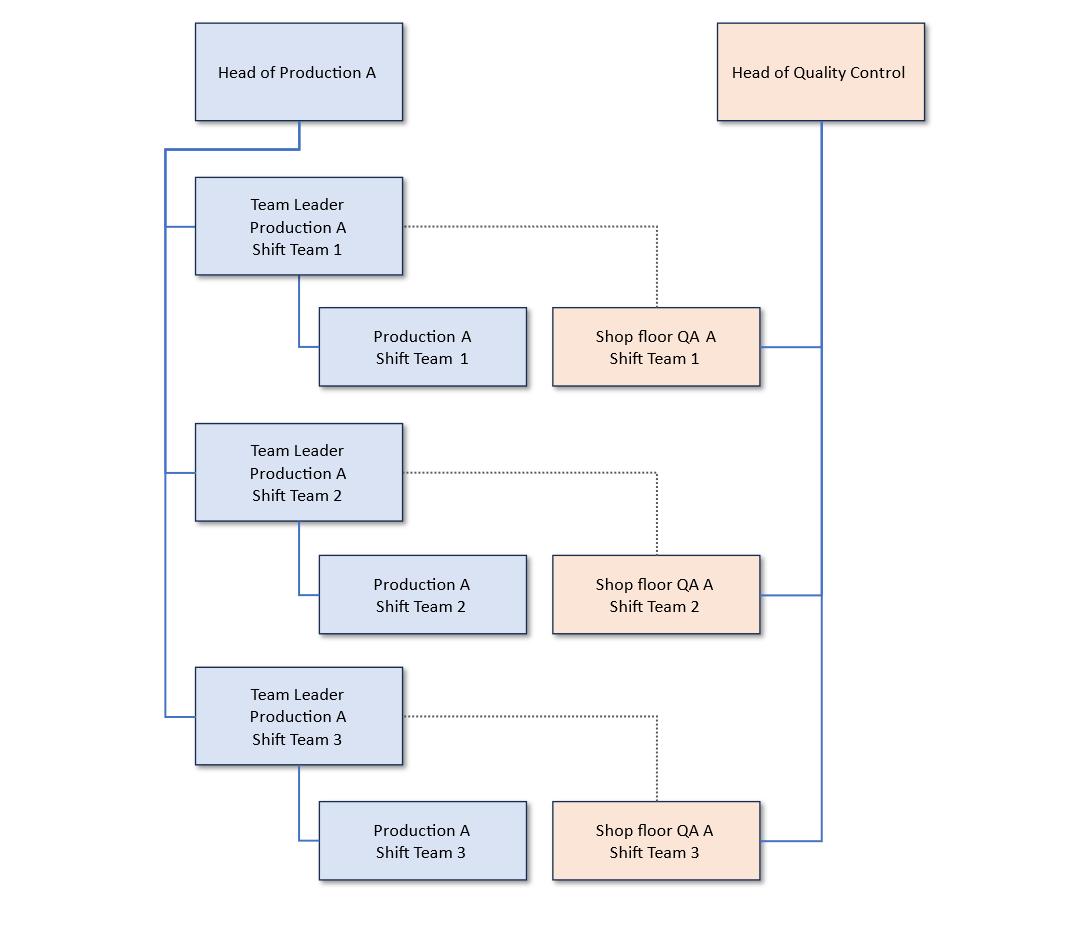
Figure 2: Example of an organigram including shop-floor QA


Do you have any questions or suggestions? Please contact us at: redaktion@gmp-verlag.de

Dr. Christian Gausepohl

You may also be interested in the following articles:

How is a QRM process initiated?

How is a QRM process initiated?

You can view the answer here:
Read more
FDA: Updated Pre-RFD Guidance for Combination Products

FDA: Updated Pre-RFD Guidance for Combination Products

The U.S. FDA has released an updated final guidance on preparing a Pre-Request for Designation (Pre-RFD), replacing the previous 2018 version. The revised document provides new recommendations for interacting with the Office of Combination Products (OCP) and clarifies expectations for Pre-RFD submissions.
Read more
EDQM: 9 Virtual Training Modules on Ph. Eur. and CEPs

EDQM: 9 Virtual Training Modules on Ph. Eur. and CEPs

The EDQM has introduced a modular training programme covering chemically defined active substances and medicinal products. It will take place between 1 and 12 December 2025.
Read more
Previous
Next

Related Products

Skip product gallery
GMP Compliance Adviser | Named User Licence | 12M

GMP Compliance Adviser | Named User Licence | 12M

The GMP Compliance Adviser is an online publication that covers all aspects of Good Manufacturing Practice (GMP) in one source.In the GMP Compliance Adviser you’ll find: GMP in Practice This part contains 21 chapters with GMP expert knowledge to base your decisions upon. It provides practical assistance with checklists, templates and SOP examples. It is written by more than 80 authors with hands-on experience directly linked to the industry. The individual chapters describe the different aspects of GMP in clear language. Technical, organizational and procedural aspects are covered.More than 700 checklists, templates and examples of standard operation procedures taken directly out of practice help you in understanding the GMP requirements.GMP RegulationsThese chapters cover the most important GMP regulations from Europe and the United States (CFR and FDA), but also PIC/S, ICH, WHO and many more.  Sample Documents In addition, the GMP Compliance Adviser contains many sample documents and practical examples that you can use.

Ready for dispatch, Delivery time appr. 2-5 workdays (2-3 weeks for christmas goodies)
€1,335.00 net excl. VAT
GMP:KnowHow Pharma Logistics (GDP) | Named User License | 12M

GMP:KnowHow Pharma Logistics (GDP) | Named User License | 12M

Your knowledge base about GDP-compliant handling of your pharmaceutical logistics. It is important that you as a logistics service provider, but also as a client in the pharmaceutical industry, adhere precisely to the regulatory requirements. The GMP:KnowHow knowledge portal guides you through the regulatory jungle of the pharmaceutical and logistical supply chain! The knowledge portal gives you an easy-to-understand overview of all the important topics. Using graphics, you can easily navigate through all the areas covered by the EU GDP Guidelines (2013/C 343/01). You also have the relevant passages of the regulations directly at hand for each topic. This allows you to compare the requirements directly and saves you a lot of time on time-consuming searches and research!One thing is certain: the knowledge portal answers your questions about the supply chain of medicinal products, active pharmaceutical ingredients and medical devices. You don't have to be an expert. Yet.You will find answers to your questions in the GMP:KnowHow Pharma Logistics (GDP). Where does GDP begin, where does GMP end? What does GDP-compliant mean? When do I also have to take GMP requirements into account? What permits do I need for certain activities? What requirements do I have to fulfil? What is the current legal basis? How am I covered? What authorizations do I have for my work, e.g. from my employer? Who is responsible — the client or the contractor? And many more What is the difference to the GMP Compliance Adviser? The GMP:KnowHow Pharma Logistics (GDP) is your guideline for Good Distribution Practice. It is a product that is independent of the GMP Compliance Adviser and concentrates on content that is essential for carriers of medicinal products, active pharmaceutical ingredients and medical devices as well as for logistics clients. The focus is on practical knowledge and how to apply it in your daily business. If necessary, the relevant regulations can be called up immediately alongside the practical knowledge, and you can see the relevant paragraphs at a glance. In addition, sample documents are available to help you make immediate progress. AuthorSimone Ferrante – now Director Quality at Fisher Clinical Services – was previously Head of Quality Control and Responsible Person according to GDP (VP) for the entire Grieshaber Group. She is also a long-standing author and GDP expert at GMP-Verlag.

Ready for dispatch, Delivery time appr. 2-5 workdays (2-3 weeks for christmas goodies)
€610.00 net excl. VAT
E-Learning GMP:READY | GMP for Engineers Online Course

E-Learning GMP:READY | GMP for Engineers Online Course

Why are GMP rules important for technicians and engineers? Technicians and engineers play a key role in ensuring compliance with Good Manufacturing Practice (GMP) standards. They are involved in critical activities such as: planning and construction of ventilation systems, maintenance of water treatment plants, calibration of measuring sensors. Therefore, they are jointly responsible for the quality of medicines and must ensure that their work complies with GMP standards.Your advantages: Fast familiarization with GMP topics in approx. 2 hours, time- and location-independent online training, printable personal certificate, 12-month access for initial and follow-up training, automatic updates in case of legal changes, content compliant with Article 7(4) of Directive 2003/94/EC.

Ready for dispatch, Delivery time appr. 2-5 workdays (2-3 weeks for christmas goodies)
€240.00 net excl. VAT
GMP Fundamentals | A Step-by-Step Guide

GMP Fundamentals | A Step-by-Step Guide

This handbook is a practical and easy to read guideline, giving you a quick and comprehensive overview of the complex world of Good Manufacturing Practice (GMP) without the need of previously acquired knowledge. Some topics are: GMP: Purpose and basic pharmaceutical terms Laws, licenses and inspections Personnel: Responsibility and hygiene Standard Operating Procedures (SOP) and documentation Design of rooms and facilities Processing and packaging Quality control and market release Suppliers, storage and logistics (Good Distribution Practice = GDP) Alphabetical index and abbreviations Using practical examples and comparisons to every-day life will help to easy understand GMP regulations.GMP Fundamentals is a helpful guide which facilitates the entry into the GMP world and teaches the necessary basics.

Ready for dispatch, delivery immediately after receipt of payment
€44.90 net excl. VAT