Skip to main content Skip to search Skip to main navigation

Contamination Control – Cleanliness Zone Concepts

Excerpt from the GMP Compliance Adviser, chapter 3.D.4 Contamination Control Strategy (CCS)

4 min. reading time | by Harald Flechl
Published in LOGFILE 32/2023

According to the new Annex 1, a Contamination Control Strategy (CCS) must be implemented for the entire cleanroom and controlled environment system of the facility.

This must define the cleanliness zone concepts with all critical control points and evaluate the effectiveness of all design, procedural, technical and organisational controls and monitoring measures used to manage the risks associated with contamination.

The CCS and the cleanliness zone concept define the quality and performance characteristics that a pharmaceutical company's cleanroom solutions must meet. This goes far beyond the assignment of air cleanliness classes and should be based not only on empirical values but also on the current state of the art.

The development of a CCS requires detailed technical and process knowledge. Companies without the corresponding expertise and experience can be supported by experienced experts (GMP consultants, planners). However, the responsibility always lies with the manufacturer, who must also contribute the process know-how.
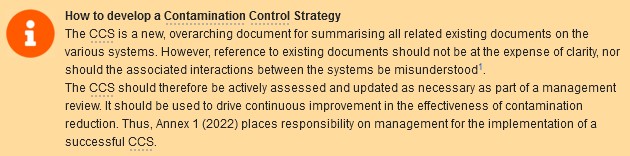
1The ECA Foundation provides a guideline for the creation of a CCS (CCS Guide Download – ECA Foundation (eca-foundation.org) – last accessed 07.02.2023


The starting point for a CCS creation could be, for example, answering the following questions:

  • What can disrupt my process?

  • Which parameters influence product quality and effectiveness?

  • How can I quickly recognise and detect changes?

  • How can I prevent change?

  • What has an impact on patient safety?

In a concise form:

  • What can contaminate the cleanroom (and the product) and how can this be detected and/or prevented as soon as possible?

For example, the following aspects should be considered for the creation of a CCS:

  • Room and process design

  • Premises and equipment

  • Material and personnel flows

  • Media supply and disposal

  • Raw material controls and in-process controls

  • Primary packaging materials and closures

  • Supplier qualification for key components/material

  • Sterilisation process validation

  • Process validation

  • Risk management within the process

  • Maintenance, servicing as part of planned and unplanned interventions without adding risk of contamination

  • Cleaning, disinfection

  • Monitoring in accordance with the state of the art and alternative methods for detecting potential contamination

  • Preventive mechanisms – such as trend analyses, root cause investigations, CAPAs, required resources

  • Continuous improvement based on information derived from the above points


Due diligence must be applied not only to GMP aspects, but also to the protection of personnel and the environment. A good basis for the planning implementation according the requirements laid down in the zone concept is provided by the EN ISO standards on cleanroom technology: the EN ISO 14644 series of standards for cleanroom technology in general and EN 17141 (replaces EN ISO 14698, withdrawn in 2021) concerning biocontamination control.

In Germany, this is supplemented by the VDI-2083 cleanroom technology guideline series, which deals with the specifications of the EN ISO 14644 standard series in greater depth and covers further reaching topics. Some of the VDI guidelines are also applied internationally.

The specifications in these standards are of a general nature, i.e. not purely pharma-specific. Therefore, some points and sections are only to be applied analogously – using ‘common sense’ – or are not to be regarded as relevant. Which points are relevant for the respective process must therefore be determined on a project-specific basis depending on the user requirements. According to current legal standards, the guidelines valid at the time of the system handover are always relevant.

For this reason, a list of the current guidelines is not provided here and reference is made to the relevant sources, e.g. Beuth Verlag, Austrian Standards Institute, etc.


Do you have any questions or suggestions? Please contact us at: redaktion@gmp-verlag.de

Harald Flechl
Harald Flechl

You may also be interested in the following articles:

How is a QRM process initiated?

How is a QRM process initiated?

You can view the answer here:
Read more
FDA: Updated Pre-RFD Guidance for Combination Products

FDA: Updated Pre-RFD Guidance for Combination Products

The U.S. FDA has released an updated final guidance on preparing a Pre-Request for Designation (Pre-RFD), replacing the previous 2018 version. The revised document provides new recommendations for interacting with the Office of Combination Products (OCP) and clarifies expectations for Pre-RFD submissions.
Read more
EDQM: 9 Virtual Training Modules on Ph. Eur. and CEPs

EDQM: 9 Virtual Training Modules on Ph. Eur. and CEPs

The EDQM has introduced a modular training programme covering chemically defined active substances and medicinal products. It will take place between 1 and 12 December 2025.
Read more
Previous
Next

Related Products

Skip product gallery
GMP Compliance Adviser | Named User Licence | 12M

GMP Compliance Adviser | Named User Licence | 12M

The GMP Compliance Adviser is an online publication that covers all aspects of Good Manufacturing Practice (GMP) in one source.In the GMP Compliance Adviser you’ll find: GMP in Practice This part contains 21 chapters with GMP expert knowledge to base your decisions upon. It provides practical assistance with checklists, templates and SOP examples. It is written by more than 80 authors with hands-on experience directly linked to the industry. The individual chapters describe the different aspects of GMP in clear language. Technical, organizational and procedural aspects are covered.More than 700 checklists, templates and examples of standard operation procedures taken directly out of practice help you in understanding the GMP requirements.GMP RegulationsThese chapters cover the most important GMP regulations from Europe and the United States (CFR and FDA), but also PIC/S, ICH, WHO and many more.  Sample Documents In addition, the GMP Compliance Adviser contains many sample documents and practical examples that you can use.

Ready for dispatch, Delivery time appr. 2-5 workdays (2-3 weeks for christmas goodies)
€1,335.00 net excl. VAT
GMP:KnowHow Pharma Logistics (GDP) | Named User License | 12M

GMP:KnowHow Pharma Logistics (GDP) | Named User License | 12M

Your knowledge base about GDP-compliant handling of your pharmaceutical logistics. It is important that you as a logistics service provider, but also as a client in the pharmaceutical industry, adhere precisely to the regulatory requirements. The GMP:KnowHow knowledge portal guides you through the regulatory jungle of the pharmaceutical and logistical supply chain! The knowledge portal gives you an easy-to-understand overview of all the important topics. Using graphics, you can easily navigate through all the areas covered by the EU GDP Guidelines (2013/C 343/01). You also have the relevant passages of the regulations directly at hand for each topic. This allows you to compare the requirements directly and saves you a lot of time on time-consuming searches and research!One thing is certain: the knowledge portal answers your questions about the supply chain of medicinal products, active pharmaceutical ingredients and medical devices. You don't have to be an expert. Yet.You will find answers to your questions in the GMP:KnowHow Pharma Logistics (GDP). Where does GDP begin, where does GMP end? What does GDP-compliant mean? When do I also have to take GMP requirements into account? What permits do I need for certain activities? What requirements do I have to fulfil? What is the current legal basis? How am I covered? What authorizations do I have for my work, e.g. from my employer? Who is responsible — the client or the contractor? And many more What is the difference to the GMP Compliance Adviser? The GMP:KnowHow Pharma Logistics (GDP) is your guideline for Good Distribution Practice. It is a product that is independent of the GMP Compliance Adviser and concentrates on content that is essential for carriers of medicinal products, active pharmaceutical ingredients and medical devices as well as for logistics clients. The focus is on practical knowledge and how to apply it in your daily business. If necessary, the relevant regulations can be called up immediately alongside the practical knowledge, and you can see the relevant paragraphs at a glance. In addition, sample documents are available to help you make immediate progress. AuthorSimone Ferrante – now Director Quality at Fisher Clinical Services – was previously Head of Quality Control and Responsible Person according to GDP (VP) for the entire Grieshaber Group. She is also a long-standing author and GDP expert at GMP-Verlag.

Ready for dispatch, Delivery time appr. 2-5 workdays (2-3 weeks for christmas goodies)
€610.00 net excl. VAT
E-Learning GMP:READY | GMP for Engineers Online Course

E-Learning GMP:READY | GMP for Engineers Online Course

Why are GMP rules important for technicians and engineers? Technicians and engineers play a key role in ensuring compliance with Good Manufacturing Practice (GMP) standards. They are involved in critical activities such as: planning and construction of ventilation systems, maintenance of water treatment plants, calibration of measuring sensors. Therefore, they are jointly responsible for the quality of medicines and must ensure that their work complies with GMP standards.Your advantages: Fast familiarization with GMP topics in approx. 2 hours, time- and location-independent online training, printable personal certificate, 12-month access for initial and follow-up training, automatic updates in case of legal changes, content compliant with Article 7(4) of Directive 2003/94/EC.

Ready for dispatch, Delivery time appr. 2-5 workdays (2-3 weeks for christmas goodies)
€240.00 net excl. VAT
GMP Fundamentals | A Step-by-Step Guide

GMP Fundamentals | A Step-by-Step Guide

This handbook is a practical and easy to read guideline, giving you a quick and comprehensive overview of the complex world of Good Manufacturing Practice (GMP) without the need of previously acquired knowledge. Some topics are: GMP: Purpose and basic pharmaceutical terms Laws, licenses and inspections Personnel: Responsibility and hygiene Standard Operating Procedures (SOP) and documentation Design of rooms and facilities Processing and packaging Quality control and market release Suppliers, storage and logistics (Good Distribution Practice = GDP) Alphabetical index and abbreviations Using practical examples and comparisons to every-day life will help to easy understand GMP regulations.GMP Fundamentals is a helpful guide which facilitates the entry into the GMP world and teaches the necessary basics.

Ready for dispatch, delivery immediately after receipt of payment
€44.90 net excl. VAT