
Comparison of cleaning processes
Excerpt from the GMP Compliance Adviser, Chapter 4.H.2.2
7 min. reading time | by Torsten Knöpke
Published in LOGFILE 09/2022
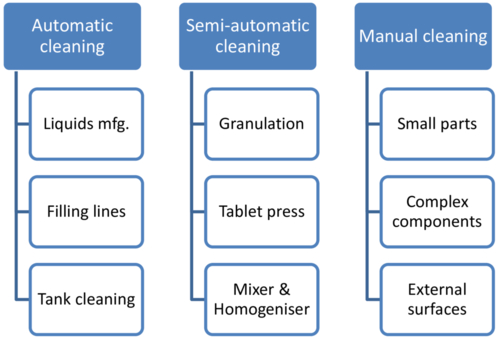
Figure 1 Application of cleaning processes in practice
When observing the use of cleaning processes, a clear trend can be seen: in the interests of increasing efficiency, cleaning processes are becoming more and more automated, and the proportion of manual cleaning is being further reduced with each new investment. A comparative study between manual and fully automated cleaning shows “that a higher degree of cleanliness can be achieved by systematically changing out the individual equipment components in conjunction with a fully automated cleaning program. Furthermore, it is possible to make a statement about the reproducibility of the process” 1.
As cost awareness continues to rise, labor- and time-intensive manual cleaning is being critically compared with automated cleaning processes. Cleaning parameters of a CIP or WIP system are easier to establish and thus more amenable to validation.
Therefore, the question arises: When is the equipment cleanable with a CIP or WIP process?
The following requirements should be met:
-
Accessibility of the surfaces through appropriate hygienic design
-
Material compatibility with the cleaning agent or disinfectant
-
Solubility of the residues
-
Definable volume for dosing the cleaning agent solution
-
Sufficient flow rates and drainage of the media
In automated cleaning, more effective cleaning conditions can also be employed. This applies in particular to the temperature ranges and the pH range of the cleaning agents used.
To a limited extent, manual cleaning can also be standardized for the individual steps, e.g. by:
-
Dosing stations for cleaning agents (prevent over- or underdosing)
-
Mixing faucet with temperature setting
-
Foam cleaning of plant components to bind toxic substances
The trend towards automation will surely continue. However, it should be noted that fully automated CIP processes are not suitable or applicable for every plant or process.
A plant that has proven to be CIP-capable for a certain product may turn out not to be CIP-capable for another product. The degree of cleanliness that can actually be achieved can only be determined on a case-by-case basis for a product or the reference substance of a product group. A CIP process is therefore specifically adapted to a particular manufacturing process. For this reason, automated WIP cleaning is a good middle ground if various individual parameters are to be taken into account.
An overview of the different processes in terms of costs, installation effort and other selection criteria is shown in Figure 2.
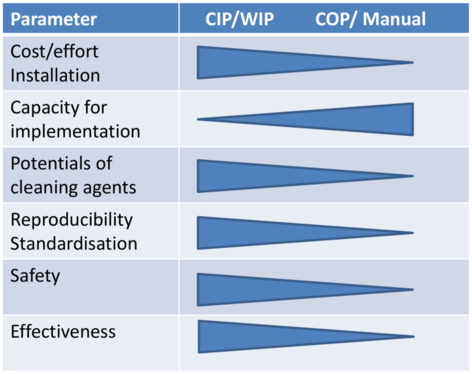
Figure 2 Comparison of cleaning processes
1 WIP/CIP und geschlossene Anlagensysteme (containment) im pharmazeutischen Feststoffbereich (WIP/CIP and Closed Equipment Systems (Containment) in the pharmaceutical solids sector)). A. Schiffmann et al., Pharmazeutische Industrie 63, Nr. 2 (2001).
Do you have any questions or suggestions? Please contact us at: redaktion@gmp-verlag.de

You may also be interested in the following articles:


