Skip to main content Skip to search Skip to main navigation

9 Check Points for the Incoming Goods Protocol at the Logistician's or Wholesaler's Premises

8 min. reading time | by Simone Ferrante
Published in LOGFILE 05/2022

Receipt of medicinal products

When materials or products are delivered, their quality is assessed. Therefore, this work step should be carried out by experienced and particularly reliable employees.

General procedure

The incoming goods control begins with checking whether the delivery corresponds to the delivery note or consignment note and corresponds to an order or an announced return. The entire delivery must be checked and the results documented. A checklist can be used for this purpose, which is to be filled out in the form of a protocol.

The incoming goods protocol must be filled out completely. The date of the delivery and the names of the employees for unloading and control must be indicated. The correctness must be confirmed with the signature(s) of the persons involved. Subsequent entries must be marked as such.

The following inspection points are to be listed on the incoming goods protocol:

  • Do the goods correspond to the information on the delivery note?
  • Can the goods be identified precisely? Check the item number, batch and expiry date/shelf life.
  • Was the correct quantity delivered?
  • Is special storage required?
  • Are the goods intact (including closure system, e.g. seal)? Check for damage or contamination.
  • If applicable: Are the security features intact?
  • For APIs: Are seals present and undamaged?
  • For APIs: Are the certificates of analysis, including those of the original manufacturer (the identity of the original manufacturer must be known to the pharmaceutical company, there is a duty to inform here), enclosed with the supplied documents?
  • For temperature-sensitive products: Are the temperature printouts of the refrigerated semi-trailer as well as those of the supplied data loggers (if any) complete and legible for the required period? Were there any temperature deviations?

A proof must be attached to the incoming goods protocol showing the batch designations of the entire delivery.

After completion of the incoming goods control, the goods are usually booked into the warehouse management system of Peither Logistik GmbH. In special cases, the receipt of the goods is confirmed directly in the customer system (warehouse management system of the pharmaceutical company).

The incoming goods process is completed when the goods have been moved to the designated storage location.


Goods receipt of medicinal products in quarantine status

As a matter of principle, medicinal products may only be placed on the market if they have been authorised for this purpose (marketing authorisation). In addition, each individual batch of medicinal products must be certified by a Qualified Person (QP) (batch certification and release for marketing, see Annex 16 EU GMP Guide).

The certification of the finished product batch may only be carried out by the QP if the required prerequisites are fulfilled. Due to the prescribed tests, batches of medicinal products often cannot be released for marketing immediately after their manufacture (e.g. waiting times for microbiological tests). This means that finished medicinal products must first be stored before they can be released for marketing. However, it must then be ensured that such non-certified batches cannot be transferred to marketable stock. This may involve physical precautions such as segregation and labelling, or electronic precautions such as the use of validated computerised systems.

Requirements for the incoming goods infrastructure

  • The incoming goods area must be protected from the weather.
  • The incoming goods area must be sufficiently separated from the storage area and the shipping area.
  • The areas where incoming goods controls are carried out should be clearly marked and adequately lit.
  • The staging areas must be large enough to be able to carry out batch separation.
  • In the case of so-called multi-user centres, care must be taken to ensure sufficient physical separation and identification when processing incoming goods for the individual customers; if physical proximity is unavoidable, e.g. due to capacity bottlenecks, separation can be made with the help of barrier tapes.

Counterfeit products

If counterfeit products are suspected, the affected cargo must be immediately physically separated from the rest of the goods. In the case of counterfeit medicines, the pharmaceutical manufacturer and the competent authority must be informed. All measures taken must be documented.


Control of temperature-sensitive products

Chilled goods and temperature-controlled transports are to be prioritised in order to bring them – after temperature control – into the temperature-controlled storage rooms as quickly as possible.

To check whether the temperature was maintained during transport, evaluate the printouts of the data loggers of the transport vehicles. If this is not possible, at least check the temperature of the delivery with a calibrated measuring device upon receipt of the goods. The results are to be documented and the records including the logger printouts are to be archived. In the event of a deviation, this is to be processed according to previously established procedures.

If larger quantities of temperature-sensitive medicines are delivered or collected daily, it makes sense to set up a loading area with direct access to the cold storage (thermal door). In this way, temperature fluctuations can be avoided and the transport routes for the sensitive medicines can be optimised.
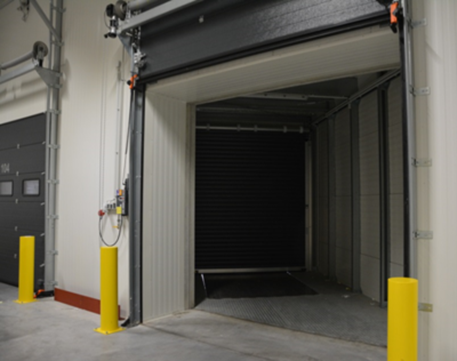
Figure 1: Thermal door in the cold store at Grieshaber Logistics Group AG


A translated and edited excerpt from our German knowledge portal GMP:KnowHow Pharmalogistik (GDP).


Do you have any questions or suggestions? Please contact us at: redaktion@gmp-verlag.de

Simone Ferrante
Simone Ferrante

You may also be interested in the following articles:

How is a QRM process initiated?

How is a QRM process initiated?

You can view the answer here:
Read more
FDA: Updated Pre-RFD Guidance for Combination Products

FDA: Updated Pre-RFD Guidance for Combination Products

The U.S. FDA has released an updated final guidance on preparing a Pre-Request for Designation (Pre-RFD), replacing the previous 2018 version. The revised document provides new recommendations for interacting with the Office of Combination Products (OCP) and clarifies expectations for Pre-RFD submissions.
Read more
EDQM: 9 Virtual Training Modules on Ph. Eur. and CEPs

EDQM: 9 Virtual Training Modules on Ph. Eur. and CEPs

The EDQM has introduced a modular training programme covering chemically defined active substances and medicinal products. It will take place between 1 and 12 December 2025.
Read more
Previous
Next

Related Products

Skip product gallery
GMP Compliance Adviser | Named User Licence | 12M

GMP Compliance Adviser | Named User Licence | 12M

The GMP Compliance Adviser is an online publication that covers all aspects of Good Manufacturing Practice (GMP) in one source.In the GMP Compliance Adviser you’ll find: GMP in Practice This part contains 21 chapters with GMP expert knowledge to base your decisions upon. It provides practical assistance with checklists, templates and SOP examples. It is written by more than 80 authors with hands-on experience directly linked to the industry. The individual chapters describe the different aspects of GMP in clear language. Technical, organizational and procedural aspects are covered.More than 700 checklists, templates and examples of standard operation procedures taken directly out of practice help you in understanding the GMP requirements.GMP RegulationsThese chapters cover the most important GMP regulations from Europe and the United States (CFR and FDA), but also PIC/S, ICH, WHO and many more.  Sample Documents In addition, the GMP Compliance Adviser contains many sample documents and practical examples that you can use.

Ready for dispatch, Delivery time appr. 2-5 workdays (2-3 weeks for christmas goodies)
€1,335.00 net excl. VAT
GMP:KnowHow Pharma Logistics (GDP) | Named User License | 12M

GMP:KnowHow Pharma Logistics (GDP) | Named User License | 12M

Your knowledge base about GDP-compliant handling of your pharmaceutical logistics. It is important that you as a logistics service provider, but also as a client in the pharmaceutical industry, adhere precisely to the regulatory requirements. The GMP:KnowHow knowledge portal guides you through the regulatory jungle of the pharmaceutical and logistical supply chain! The knowledge portal gives you an easy-to-understand overview of all the important topics. Using graphics, you can easily navigate through all the areas covered by the EU GDP Guidelines (2013/C 343/01). You also have the relevant passages of the regulations directly at hand for each topic. This allows you to compare the requirements directly and saves you a lot of time on time-consuming searches and research!One thing is certain: the knowledge portal answers your questions about the supply chain of medicinal products, active pharmaceutical ingredients and medical devices. You don't have to be an expert. Yet.You will find answers to your questions in the GMP:KnowHow Pharma Logistics (GDP). Where does GDP begin, where does GMP end? What does GDP-compliant mean? When do I also have to take GMP requirements into account? What permits do I need for certain activities? What requirements do I have to fulfil? What is the current legal basis? How am I covered? What authorizations do I have for my work, e.g. from my employer? Who is responsible — the client or the contractor? And many more What is the difference to the GMP Compliance Adviser? The GMP:KnowHow Pharma Logistics (GDP) is your guideline for Good Distribution Practice. It is a product that is independent of the GMP Compliance Adviser and concentrates on content that is essential for carriers of medicinal products, active pharmaceutical ingredients and medical devices as well as for logistics clients. The focus is on practical knowledge and how to apply it in your daily business. If necessary, the relevant regulations can be called up immediately alongside the practical knowledge, and you can see the relevant paragraphs at a glance. In addition, sample documents are available to help you make immediate progress. AuthorSimone Ferrante – now Director Quality at Fisher Clinical Services – was previously Head of Quality Control and Responsible Person according to GDP (VP) for the entire Grieshaber Group. She is also a long-standing author and GDP expert at GMP-Verlag.

Ready for dispatch, Delivery time appr. 2-5 workdays (2-3 weeks for christmas goodies)
€610.00 net excl. VAT
E-Learning GMP:READY | GMP for Engineers Online Course

E-Learning GMP:READY | GMP for Engineers Online Course

Why are GMP rules important for technicians and engineers? Technicians and engineers play a key role in ensuring compliance with Good Manufacturing Practice (GMP) standards. They are involved in critical activities such as: planning and construction of ventilation systems, maintenance of water treatment plants, calibration of measuring sensors. Therefore, they are jointly responsible for the quality of medicines and must ensure that their work complies with GMP standards.Your advantages: Fast familiarization with GMP topics in approx. 2 hours, time- and location-independent online training, printable personal certificate, 12-month access for initial and follow-up training, automatic updates in case of legal changes, content compliant with Article 7(4) of Directive 2003/94/EC.

Ready for dispatch, Delivery time appr. 2-5 workdays (2-3 weeks for christmas goodies)
€240.00 net excl. VAT
GMP Fundamentals | A Step-by-Step Guide

GMP Fundamentals | A Step-by-Step Guide

This handbook is a practical and easy to read guideline, giving you a quick and comprehensive overview of the complex world of Good Manufacturing Practice (GMP) without the need of previously acquired knowledge. Some topics are: GMP: Purpose and basic pharmaceutical terms Laws, licenses and inspections Personnel: Responsibility and hygiene Standard Operating Procedures (SOP) and documentation Design of rooms and facilities Processing and packaging Quality control and market release Suppliers, storage and logistics (Good Distribution Practice = GDP) Alphabetical index and abbreviations Using practical examples and comparisons to every-day life will help to easy understand GMP regulations.GMP Fundamentals is a helpful guide which facilitates the entry into the GMP world and teaches the necessary basics.

Ready for dispatch, delivery immediately after receipt of payment
€44.90 net excl. VAT