Skip to main content Skip to search Skip to main navigation

WHO: Draft on Regulatory Ovesight of Disposal of Medical Products

WHO published a draft consultation document on regulatory oversight of disposal of medical products throughout the lifecycle.

Improper disposal of pharmaceutical waste can promote the emergence and spread of antimicrobial resistance (AMR), leading to difficult-to-treat infections. It also poses health risks, including respiratory diseases, endocrine disruption, radiation poisoning, and certain cancers. In addition, pharmaceutical waste can contaminate air, water, soil, and agricultural systems, causing significant environmental and food safety concerns.

WHO recommends that National Regulatory Authorities (NRAs) establish or update legal frameworks for the safe disposal of unwanted medical products. Authorities should implement risk-based inspections, oversee the entire disposal process through appropriate documentation and traceability, license and supervise waste management providers, and introduce controls to prevent diversion, falsification, and environmental contamination. In addition, NRAs are encouraged to provide training, promote public awareness, and strengthen collaboration with environmental and other competent authorities.

Comments should be submitted through the online PleaseReview™ platform by 22 August 2026.

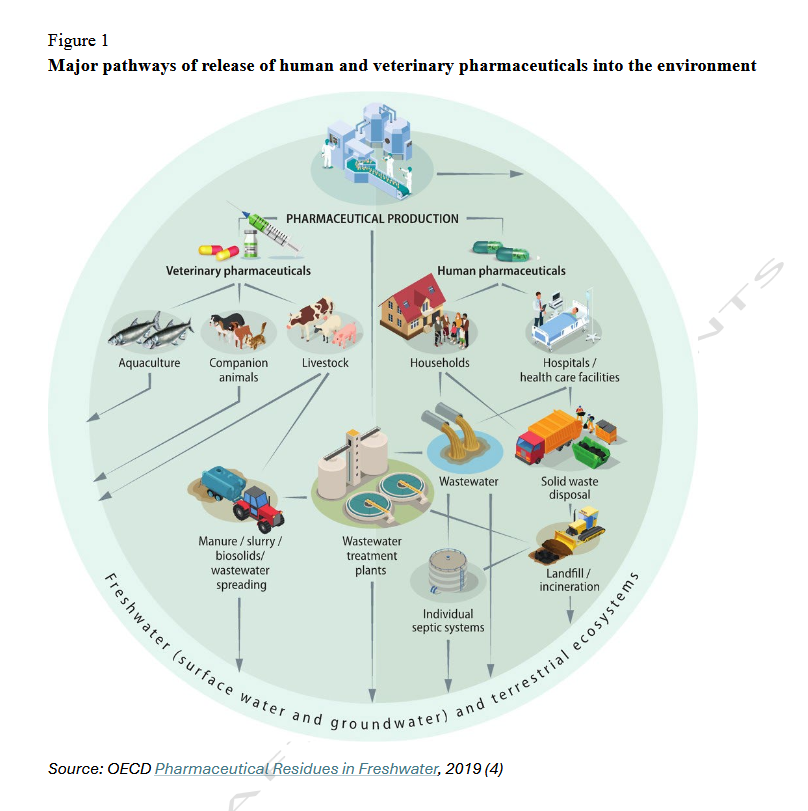
Figure 1 highlights the main pathways of entry of human and veterinary pharmaceuticals into the environment during routine production and use.

Source:

WHO: DRAFT WORKING DOCUMENT FOR COMMENTS: Good practices for regulatory oversight of the disposal of medical products throughout their life cycle

Meet the GMP Compliance Adviser

The GMP Compliance Adviser is the world's largest knowledge portal for quality management in the pharma business. 

The demo access is non-binding and ends automatically.

Test it now for free

You may also be interested in the following articles:

Swissmedic: Implementation of New EU GMP Implementing Regulations for Veterinary Medicinal Products

Swissmedic: Implementation of New EU GMP Implementing Regulations for Veterinary Medicinal Products

The new EU Implementing Regulations on GMP requirements for veterinary medicinal products and active substances will not be automatically transposed into the Swiss Medicinal Products Licensing Ordinance (MPLO) on 16 July 2026. Swissmedic has confirmed that, although the structure of the new EU legislation has changed, the underlying GMP requirements remain largely unchanged.
Read more
EU: Annexes 4 and 5 no Longer Included in the EU GMP Guide

EU: Annexes 4 and 5 no Longer Included in the EU GMP Guide

Following the entry into application of Commission Implementing Regulations (EU) 2025/2091 and (EU) 2025/2154 on the principles and guidelines of Good Manufacturing Practice (GMP) for veterinary medicinal products and active substances for veterinary medicinal products on 16 July 2026, the European Commission removed Annexes 4 and 5 from the EU GMP Guide.
Read more
EMA: Revision of Annex 15 Delayed

EMA: Revision of Annex 15 Delayed

In February 2026, the EMA published a concept paper on the revision of Annex 15 "Qualification and Validation" of the EU GMP Guide (we reported previously). The Agency has now released a corrected version containing a significantly revised timetable.
Read more
EU: Updated Q&A on Safety Features for Human Medicinal Products

EU: Updated Q&A on Safety Features for Human Medicinal Products

The European Commission has published Version 22 of its Questions and Answers on Safety Features for Medicinal Products for Human Use.
Read more
EMA: Q&A Paper on Measures to Prevent Microbial Contamination of Non-Sterile Medicinal Products

EMA: Q&A Paper on Measures to Prevent Microbial Contamination of Non-Sterile Medicinal Products

The EMA has published a new Q&A paper on technical and organisational measures to prevent microbial contamination of non-sterile medicinal products.
Read more
When APS Fail and First Air is at Risk

When APS Fail and First Air is at Risk

At the PDA Good Aseptic Manufacturing Conference 2026, Alberto Gonzales (Takeda) discussed challenges and practical solutions related to aseptic process simulations (APS). Anna Campanella (Takeda) and Hussein Bachir (Franz Ziel) explored how first air protection in aseptic processing can be compromised by equipment design, glove interventions, and operator activities.
Read more
Previous
Next