Skip to main content Skip to search Skip to main navigation

Agency Expectations on PDE Determination and PDE Reports

7 min. reading time | by Sabine Paris, PhD
Published in LOGFILE 14/2024

In 2015, with the revision of Chapters 3 and 5 and Annex 15 of the EU GMP Guide and with the publication of the EMA PDE Guideline a paradigm shift occurred in the setting of limits for the validation of cleaning processes. Instead of the previously used criteria, such as 10 ppm or 1/1000 of the therapeutic dose of the foregoing product, the only acceptable criterion is now a toxicological risk assessment based on PDE values.

Whether you prepare the required assessments yourself or have them prepared by external toxicologists, you should know the answers to these two questions: What elements should a PDE report contain? What do GMP inspectors look for?

The following overview shows the specific requirements of national and international regulatory documents for the determination of PDE values and PDE reports.


EMA PDE Guideline

(Guideline on setting health based exposure limits for use in risk identification in the manufacture of different medicinal products in shared facilities, EMA/CHMP/ CVMP/ SWP/169430/2012, 2014)

  • The identification of a “critical effect” in the establishment of a PDE should be based on a comprehensive literature search including handbook and monographs as well as searches in electronic scientific databases.
  • The search strategy and the results of the search must be clearly documented.
  • The company should provide a discussion with respect to the critical endpoints of concern and their rationale for the choice of endpoints and dose that is to be used in the derivation of the PDE (No Observed Adverse Effect Level, NOAEL, Lowest Observed Adverse Effect Level,LOAEL).
  • The pivotal animal and human studies used for the derivation of the PDE should be sourced to the original reference and reviewed regarding their quality (study design, description of finding, accuracy of the report etc.)
  • The PDE determination strategy should provide a clear rationale regarding the adjustment factors that were applied in deriving the PDE.
  • In order to provide an overview to the GMP inspectors, the initial page of any prepared PDE determination strategy document should be a summary of the assessment process (see figure 1).
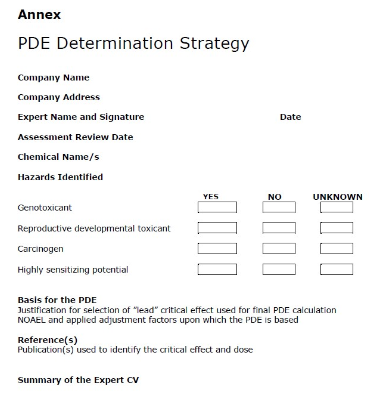
Figure 1 Example for an initial page of a PDE report (Source: EMA PDE Guideline)


Aide Mémoire 07120104 of the German GMP Inspectorates: Supervision of Drug Manufacturers (2019)

Prevention of cross-contamination

Knowledge-based toxicological evaluation of the active substances used:

  • Toxicological evaluation according to EMA Guideline
  • Calculation of the PDE values
    • Initial data basis and validity, scope of research, technical competence, documentation of the procedure
    • Identification of critical effects
    • Determination of the NOAEL(s) or LOAEL(s)
    • Determination of safety factors (also depending on initial values)
    • Method of calculating PDE values
    • For each application form and critical effect a PDE calculation must be carried out.
  • Selection of the lowest PDE value as the basis for calculating the residual limit for the cleaning validation
  • Analytical ability to determine residual quantities in the calculated range
    • Quality risk management to assess and control the risk and the measures to be defined accordingly

Aide Mémoire 07123001 of the German GMP Inspectorates: Inspection of Cleaning Validation and Verification (2023)

At least the following information should be up-to-date and readily available:

  • An overview of the potential degradation products of the active substance and excipients, if applicable, and an evaluation/assessment of the health risk (e.g. literature search)
  • For each potentially health relevant residue:
    • The underlying health-based exposure limit (HBEL = PDE):
      • Separately for different routes of exposure (if next products are manufactured to be administered by different routes)
      • Taking into account pharmacological effects, which may lead to an undesirable interaction with the next product as an impurity in the next product
      • Including the reference number of the toxicological report
  • An overview of next products with a risk of contamination with product contact surfaces including residue limits
    • Maximum daily dose
    • Route of administration (peroral, parenteral, pulmonary, etc.)
    • Minimum batch size in which the next product is manufactured
  • In the case of contract manufacturing, the client must give the contractor access to the toxicological and pharmacological data! This is best addressed in the delineation of responsibility contract!
  • When determining a "worst case" residue, the toxicological risks of a product and its cleanability must not be considered together!

PIC/S Aide-memoire for Inspection of Health Based Exposure Limit (HBEL) Assessments and Use in Quality Risk Management (PI 052-1, 2020)

An HBEL (PDE) assessment report should have:

  • A summary of the decisions, justification and final HBEL figure (HBEL = PDE).
  • Be signed and dated by the person(s) conducting the assessment and include or reference their Curriculum Vitae (CV).
  • Comprehensive literature search consulted as part of the assessment.
  • Clearly documented search strategy Results of the search and commentary on findings.
  • Identification of critical effects and points of departure that will be used in HBEL calculations – nonclinical data and clinical experience. Clear rationale for assignment of adjustment factors

The conclusions recorded in the summary should be drawn from specific points made in the text of the document and should not have excluded any points made without clear justification.

Is there a plausible explanation of why the search used was considered most appropriate?

Does the report account for the data found through the search? Are aspects searched, where no information was found related to the product, also recorded e.g. carcinogenicity?

Typically, the lowest HBEL value obtained will be used. If not, this should be justified. If concerned about this, you may wish to seek an expert opinion should the control of the product in shared facilities be high risk.

A rationale for the selection of AFs should be recorded in support of the HBEL calculation. An explanation should be provided for the effect on HBEL for differentroutes of administration (of potentially contaminated products) and for Veterinary Medicinal Products, any susceptibility for specific species.

A CV should provide evidence of the qualifications (typically pharmacy, pharmacology or other relevant pharmaceutical science degree), background in toxicology with reasonable previous experience indetermination of health-based exposure assessments such as:

  • Occupational Exposure Limit (OEL)
  • Residual solvent
  • Elemental impurities (by establishing PDE).

Sources:

Guideline on setting health based exposure limits for use in risk identification in the manufacture of different medicinal products in shared facilities, EMA/CHMP/ CVMP/ SWP/169430/2012, 2014 – GMP Compliance Adviser, Chapter C.3.3.7

Aide Mémoire 07120104 der ZLG: Überwachung von Arzneimittelherstellern (Formular 071201_F01_02, optionale Berichtsvorlage, 2019), https://www.zlg.de/index.php?eID=dumpFile&t=f&f=6048&token=3af43aaa1c9ddc1b00e0f7a413505f6e5ae2fc33

Aide Mémoire 07123001 der ZLG: Inspektion der Reinigungsvalidierung und –verifizierung (2023), https://www.zlg.de/index.php?eID=dumpFile&t=f&f=8695&token=a9cb7dd02bee0bf075c73639257e7db467160edb

PIC/S Aide-memoire for Inspection of Health Based Exposure Limit (HBEL) Assessments and Use in Quality Risk Management (PI 052-1, 2020),
https://picscheme.org/users_uploads/news_news_documents/5ef0b5df2ee1a.pdf


Do you have any questions or suggestions? Please contact us at: redaktion@gmp-verlag.de

Dr. Sabine Paris
Dr. Sabine Paris

You may also be interested in the following articles:

News: EMA

EMA: Latest Report on the International GMP Inspection Programme for API Manufacturers

EMA has published a new report on the International Active Pharmaceutical Ingredient Inspection Programme, covering the period 2017–2024. During this time, the number of participating authorities increased from ten to 13. Information was shared on 936 inspected sites and 1,684 inspections.
Read more
News: EMA

EMA Updates Procedure for Coordinating GMP Inspections

EMA has updated its procedure for coordinating GMP inspections for centrally authorised medicinal products. Version 3 has applied since 10 September 2026 and replaces Version 2. The document forms part of the Compilation of Union Procedures on Inspections and Exchange of Information (CoUP), which comprises the EU procedures and templates for GMP and GDP inspections.
Read more
Swissmedic Updates Guidance on GMP Compliance of Foreign Manufacturers

Swissmedic Updates Guidance on GMP Compliance of Foreign Manufacturers

Swissmedic has revised its guidance document “GMP compliance by foreign manufacturers”. The new Version 7.0 has been valid since 7 September 2026. In particular, it introduces new provisions for demonstrating the GMP compliance of manufacturers inspected by the US FDA. 
Read more
Swissmedic Updates Requirements for Cooperation with Pre-Wholesalers

Swissmedic Updates Requirements for Cooperation with Pre-Wholesalers

Swissmedic has revised its Technical Interpretation “Market release and distribution in cooperation with a pre-wholesaler”. The document addresses market release and distribution where a Marketing Authorisation Holder works with a pre-wholesaler (logistics and distribution service provider).
Read more
News: Europe

IPEC Updates Two Guides on Pharmaceutical Excipients

The IPEC Federation has updated two key guides on pharmaceutical excipients. The IPEC Composition Guide for Pharmaceutical Excipients (Version 3, 2026) describes an approach for manufacturers to establish excipient composition profiles. The revised version now covers biotechnology- and fermentation-derived excipients, provides further details on component types and physicochemical characterisation, and includes an example composition profile template.
Read more
Applying the FDA’s 7-Step Model for AI/ML Validation in GMP Environments: One Year Later

Applying the FDA’s 7-Step Model for AI/ML Validation in GMP Environments: One Year Later

Artificial intelligence is becoming increasingly important in GMP-regulated environments, presenting companies with new regulatory challenges. This article summarizes the latest regulatory developments, introduces a validation framework based on the FDA's seven-step model, and outlines initial practical experience with AI/ML validation.

Read more
Previous
Next

Related Products

Skip product gallery
GMP Compliance Adviser | Named User Licence | 12M

GMP Compliance Adviser | Named User Licence | 12M

With an named user licence, one user can access the knowledge portal; with a corporate licence, any number of users can access it.Approx. 5,000 pages of practical GMP knowledge with illustrations and forms: Practical guidance for rapid implementation in the workplaceDetailed descriptions of GMP-compliant systemsInternational laws and guidelines Always up-to-date thanks to regular updates Download Advantages and Prices60+ Sample Documents In addition, the GMP Compliance Adviser contains more than 60 sample documents (MS Office) and practical examples that you can use.Sample SOPsSample FormsSample ReportsSample DocumentationChecklistsProcess Diagrams (Flowcharts)Practical Examples of QRM Application (e.g., Risk Analyses)Sample Documents for Qualification and ValidationCase StudiesWritten by more than 80 authors with hands-on experience directly linked to the industryA team of over 80 experts interpret regulatory requirements and describe how they are implemented in practice.The authors are experienced in the pharmaceutical industry, consulting, and government agencies.

delivery time appr. 2-5 workdays after receipt of payment
€1,368.00 net excl. VAT
GMP:KnowHow Pharma Logistics (GDP) | Named User Licence | 12M

GMP:KnowHow Pharma Logistics (GDP) | Named User Licence | 12M

Your knowledge portal for GDP-compliant pharmaceutical logistics.  It is important that you as a logistics service provider, but also as a client in the pharmaceutical industry, comply with regulatory requirements. The GMP:KnowHow knowledge portal guides you through the complex regulatory landscape of the pharmaceutical and logistical supply chain! The knowledge portal gives you an easy-to-understand overview of all the important topics. Interactive graphics help you navigate all areas covered by the EU GDP Guidelines (2013/C 343/01). You also have the relevant passages of the regulations directly at hand for each topic. This allows you to compare the requirements directly and saves valuable research time.One thing is certain: the knowledge portal answers your questions about the supply chain of medicinal products, active pharmaceutical ingredients and medical devices. You don't have to be an expert. Yet.You will find answers to your questions in the GMP:KnowHow Pharma Logistics (GDP). Where does GDP begin, where does GMP end? What does GDP-compliant mean? When do I also have to take GMP requirements into account? What permits do I need for certain activities? What requirements do I have to fulfil? What is the current legal basis? How am I covered? What authorizations do I have for my work, e.g. from my employer? Who is responsible — the client or the contractor? And many more What is the difference to the GMP Compliance Adviser? GMP:KnowHow Pharma Logistics (GDP) is a practical knowledge portal dedicated to Good Distribution Practice (GDP). It is a product that is independent of the GMP Compliance Adviser and concentrates on content that is essential for carriers of medicinal products, active pharmaceutical ingredients and medical devices as well as for logistics clients. The focus is on practical knowledge and how to apply it in your daily business. If necessary, the relevant regulations can be called up immediately alongside the practical knowledge, and you can see the relevant paragraphs at a glance. In addition, sample documents are available to help you make immediate progress. AuthorSimone Ferrante, currently Director Quality at Fisher Clinical Services, previously served as Head of Quality Control and Responsible Person (GDP) for the Grieshaber Group. She is also a long-standing author and GDP expert at GMP-Verlag.

delivery time appr. 2-5 workdays after receipt of payment
€610.00 net excl. VAT
E-Learning GMP:READY | Specialist Knowledge GMP for Engineers

E-Learning GMP:READY | Specialist Knowledge GMP for Engineers

Why are GMP rules important for technicians and engineers? Technicians and engineers play a key role in ensuring compliance with Good Manufacturing Practice (GMP) standards. They are involved in critical activities such as: planning and construction of ventilation systems, maintenance of water treatment plants, calibration of measuring sensors. Therefore, they are jointly responsible for the quality of medicines and must ensure that their work complies with GMP standards.Your advantages: Fast familiarization with GMP topics in approx. 2 hours, time- and location-independent online training, printable personal certificate, 12-month access for initial and follow-up training, automatic updates in case of legal changes,content compliant with Article 7(4) of Directive 2003/94/EC.The Author This e-learning course was developed with the collaboration of Dipl.-Ing. Andreas Nuhn (D & B Pharmadesign GmbH).

delivery time appr. 2-5 workdays after receipt of payment
€245.00 net excl. VAT
GMP Fundamentals | A Step-by-Step Guide

GMP Fundamentals | A Step-by-Step Guide

This handbook is a practical and easy to read guideline, giving you a quick and comprehensive overview of the complex world of Good Manufacturing Practice (GMP) without the need of previously acquired knowledge. Some topics are: GMP: Purpose and basic pharmaceutical terms Laws, licenses and inspections Personnel: Responsibility and hygiene Standard Operating Procedures (SOP) and documentation Design of rooms and facilities Processing and packaging Quality control and market release Suppliers, storage and logistics (Good Distribution Practice = GDP) Alphabetical index and abbreviations Using practical examples and comparisons to every-day life will help to easy understand GMP regulations.GMP Fundamentals is a helpful guide which facilitates the entry into the GMP world and teaches the necessary basics.

delivery immediately after receipt of payment
€44.90 net excl. VAT