Skip to main content Skip to search Skip to main navigation

The New ICH Q9 Guideline: The Next Generation of Quality Management

A report from the PDA/FDA Joint Regulatory Conference 2023

7 min. reading time | by Thomas Peither
Published in LOGFILE 37/2023

Subjectivity in QRM should be addressed in every organisation. I had the opportunity to attend a very stimulating presentation by Alex Viehmann, Division Director at OPQ, CDER, U.S. FDA, who shared insights into the new ICH Q9 Guideline on Quality Risk Management (QRM) at the PDA/FDA Joint Regulatory Conference 2023, 18-20 September in Washington.

One key topic that caught my attention was "Subjectivity in QRM".
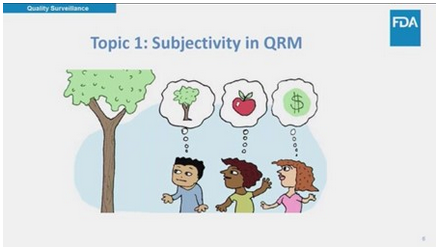
The problem with subjectivity:

Subjectivity in risk assessment and QRM processes can be problematic for several reasons. It deviates from the fundamental QRM principle of basing risk development on scientific evidence, which is ultimately linked to patient protection. Subjectivity can manifest itself in different ways, ranging from different stakeholder perceptions of hazards, risks and harms, to biases, assumptions and the use of risk scoring methods. This subjectivity can lead to biased risk assessments, suboptimal risk controls, poor risk-based decisions and ineffective QRM outcomes.


The risks of subjectivity:

  • Hazards may be inadequately identified, resulting in unmanaged risks.
  • Probabilities of occurrence and severity of harm may be inaccurately estimated in risk assessments.
  • Subjective assumptions about the value and effectiveness of risk controls can lead to overestimation of risk reduction, creating a false sense of security.

The benefits of controlling subjectivity:

Efforts to minimise subjectivity in QRM yield significant benefits:

  • Fewer quality defects, improved patient safety.
  • Science-based manufacturing processes, control strategies and validation activities.
  • Potential cost reductions and reallocation of resources to critical activities.
  • Accelerated implementation of key guidelines such as Q8, Q10, Q11 and Q12 due to the fundamental importance of QRM.

Let's embrace objective QRM!

In an industry where patient safety and product quality are paramount, addressing subjectivity in QRM is critical. We must collectively acknowledge, anticipate and control subjectivity through bias mitigation, informed tool use and data maximisation. Resource constraints should never compromise the rigour of the QRM process.

Alex Viehmann's insights remind us that objective, science-based risk assessments enable us to create safer products, optimise operations and accelerate the implementation of critical quality policies. Let's embark on this journey towards more robust and effective quality risk management!


Lifecycle Management of Risks to Ensure an Ongoing State of Control

Denise DiGiulio, Head of Global Audit and Inspection Management at Genentech, shared some valuable perspectives on implementing the ICH Q9 Guideline for Quality Risk Management. Here's some insight from her enlightening presentation at the PDA/FDA Joint Regulatory Conference 2023:
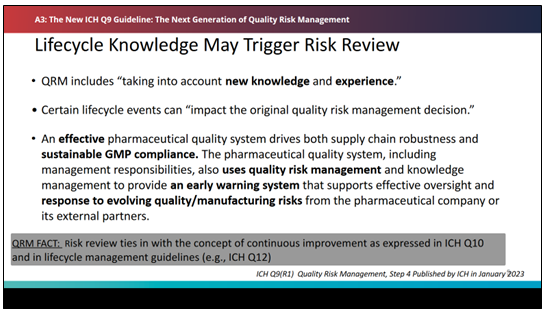
Quality Risk Management (QRM) is about staying ahead of the curve by "taking into account new knowledge and experience”. In our ever-evolving pharmaceutical landscape, adaptability is key!

Lifecycle events can have a significant impact on our initial quality risk management decisions. Flexibility and a proactive approach are essential.

An effective pharmaceutical quality system isn't just about compliance; it's a driving force behind supply chain robustness and sustainable GMP compliance.

It also acts as an early warning system, leveraging quality risk management and knowledge management. This dynamic duo helps us stay vigilant and respond effectively to evolving quality and manufacturing risks, whether they come from within our organisation or from external partners.

Denise's insights underscore the importance of continuous learning and adaptation in the pharmaceutical industry. Let's embrace these principles to ensure the safety and quality of our products. Thank you, Denise, and thank you to the PDA for bringing these issues to the stage.


Do you have any questions or suggestions? Please contact us at: redaktion@gmp-verlag.de

Thomas Peither
Thomas Peither

You may also be interested in the following articles:

Question of the Week | GMP-Verlag

Why is it Important to use Consistent Microbiological Air Monitoring Methods in Pharmaceutical Cleanrooms?

Here's the answer:
Read more
Cleaning Validation: When PDE Reports and the Worst-Case Selection do not Align

Cleaning Validation: When PDE Reports and the Worst-Case Selection do not Align

Robust PDE reports form the basis of risk-based cleaning validation. This article highlights common deficiencies identified during GMP inspections and explains how they can be avoided.

Read more
News: Europe

EDQM: New Working Party on 3D-printed Medicinal Products

The European Pharmacopoeia Commission (EPC) approved the creation of a working party on 3D-printed medicinal products. Its aim is to support the development of appropriate quality standards in the European Pharmacopoeia (Ph. Eur.).
Read more
EMA: 14 New Nitrosamines for Appendix 1

EMA: 14 New Nitrosamines for Appendix 1

Appendix 1 of EMA’s Questions and Answers on nitrosamine impurities has been updated. This appendix contains acceptable intakes (AIs) established for N-nitrosamines.
Read more
WHO: Draft Revision of its Guidelines on Quality Risk Management

WHO: Draft Revision of its Guidelines on Quality Risk Management

WHO published a revised draft of its “WHO guidelines on quality risk management”. Working document QAS/26.994 is open for public comment until 15 November 2026.
Read more
News: Artificial Intelligence

Annex 22: Results of the EMA Workshop

On 30 June, the EMA’s Annex 22 Working Group discussed the future scope of the annex with AI experts and representatives of the pharmaceutical industry (as previously reported).
Read more
Previous
Next

Related Products

Skip product gallery
GMP Compliance Adviser | Named User Licence | 12M

GMP Compliance Adviser | Named User Licence | 12M

With an named user licence, one user can access the knowledge portal; with a corporate licence, any number of users can access it.Approx. 5,000 pages of practical GMP knowledge with illustrations and forms: Practical guidance for rapid implementation in the workplaceDetailed descriptions of GMP-compliant systemsInternational laws and guidelines Always up-to-date thanks to regular updates Download Advantages and Prices60+ Sample Documents In addition, the GMP Compliance Adviser contains more than 60 sample documents (MS Office) and practical examples that you can use.Sample SOPsSample FormsSample ReportsSample DocumentationChecklistsProcess Diagrams (Flowcharts)Practical Examples of QRM Application (e.g., Risk Analyses)Sample Documents for Qualification and ValidationCase StudiesWritten by more than 80 authors with hands-on experience directly linked to the industryA team of over 80 experts interpret regulatory requirements and describe how they are implemented in practice.The authors are experienced in the pharmaceutical industry, consulting, and government agencies.

delivery immediately after receipt of payment
€1,368.00 net excl. VAT
GMP:KnowHow Pharma Logistics (GDP) | Named User Licence | 12M

GMP:KnowHow Pharma Logistics (GDP) | Named User Licence | 12M

Your knowledge portal for GDP-compliant pharmaceutical logistics.  It is important that you as a logistics service provider, but also as a client in the pharmaceutical industry, comply with regulatory requirements. The GMP:KnowHow knowledge portal guides you through the complex regulatory landscape of the pharmaceutical and logistical supply chain! The knowledge portal gives you an easy-to-understand overview of all the important topics. Interactive graphics help you navigate all areas covered by the EU GDP Guidelines (2013/C 343/01). You also have the relevant passages of the regulations directly at hand for each topic. This allows you to compare the requirements directly and saves valuable research time.One thing is certain: the knowledge portal answers your questions about the supply chain of medicinal products, active pharmaceutical ingredients and medical devices. You don't have to be an expert. Yet.You will find answers to your questions in the GMP:KnowHow Pharma Logistics (GDP). Where does GDP begin, where does GMP end? What does GDP-compliant mean? When do I also have to take GMP requirements into account? What permits do I need for certain activities? What requirements do I have to fulfil? What is the current legal basis? How am I covered? What authorizations do I have for my work, e.g. from my employer? Who is responsible — the client or the contractor? And many more What is the difference to the GMP Compliance Adviser? GMP:KnowHow Pharma Logistics (GDP) is a practical knowledge portal dedicated to Good Distribution Practice (GDP). It is a product that is independent of the GMP Compliance Adviser and concentrates on content that is essential for carriers of medicinal products, active pharmaceutical ingredients and medical devices as well as for logistics clients. The focus is on practical knowledge and how to apply it in your daily business. If necessary, the relevant regulations can be called up immediately alongside the practical knowledge, and you can see the relevant paragraphs at a glance. In addition, sample documents are available to help you make immediate progress. AuthorSimone Ferrante, currently Director Quality at Fisher Clinical Services, previously served as Head of Quality Control and Responsible Person (GDP) for the Grieshaber Group. She is also a long-standing author and GDP expert at GMP-Verlag.

delivery immediately after receipt of payment
€610.00 net excl. VAT
E-Learning GMP:READY | Specialist Knowledge GMP for Engineers

E-Learning GMP:READY | Specialist Knowledge GMP for Engineers

Why are GMP rules important for technicians and engineers? Technicians and engineers play a key role in ensuring compliance with Good Manufacturing Practice (GMP) standards. They are involved in critical activities such as: planning and construction of ventilation systems, maintenance of water treatment plants, calibration of measuring sensors. Therefore, they are jointly responsible for the quality of medicines and must ensure that their work complies with GMP standards.Your advantages: Fast familiarization with GMP topics in approx. 2 hours, time- and location-independent online training, printable personal certificate, 12-month access for initial and follow-up training, automatic updates in case of legal changes,content compliant with Article 7(4) of Directive 2003/94/EC.The Author This e-learning course was developed with the collaboration of Dipl.-Ing. Andreas Nuhn (D & B Pharmadesign GmbH).

delivery time appr. 2-5 workdays after receipt of payment
€245.00 net excl. VAT
GMP Fundamentals | A Step-by-Step Guide

GMP Fundamentals | A Step-by-Step Guide

This handbook is a practical and easy to read guideline, giving you a quick and comprehensive overview of the complex world of Good Manufacturing Practice (GMP) without the need of previously acquired knowledge. Some topics are: GMP: Purpose and basic pharmaceutical terms Laws, licenses and inspections Personnel: Responsibility and hygiene Standard Operating Procedures (SOP) and documentation Design of rooms and facilities Processing and packaging Quality control and market release Suppliers, storage and logistics (Good Distribution Practice = GDP) Alphabetical index and abbreviations Using practical examples and comparisons to every-day life will help to easy understand GMP regulations.GMP Fundamentals is a helpful guide which facilitates the entry into the GMP world and teaches the necessary basics.

delivery immediately after receipt of payment
€44.90 net excl. VAT