Skip to main content Skip to search Skip to main navigation

Process Models for the Validation of Excel Applications

Excerpt of the GMP Compliance Adviser, Chapers 9.H.4.3,  9.H.5.2 and 9.H.5.5

8 min. reading time | by Thomas Trantow, PhD
Published in LOGFILE 45/2021

Definition of the types of Excel applications
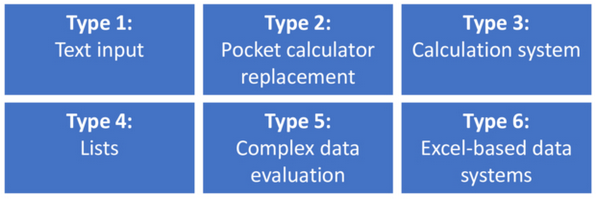
Figure 9.H-7 Types of Excel application

The types of Excel application acceptable for use in an organisation (in a department) should be clearly regulated. Suitable process models should be defined in the SOP for these types.


Process model for type 1: text input

Figure 9.H-9 Type 1: Text input

These types of Excel applications are rather unusual. They harbour three risks:

  1. They are not what they are expected to be (i.e. they contain formulas/calculations/external references or something else that is not detectable in the printout and therefore cannot be checked adequately, and/or
  2. They are too large and are not checked completely, or
  3. They are regarded as part of a data system and are not checked in any way.

Sufficient instructions in the SOP help regulate the process and bring it under control. Compliance with the specified workflow has to be ensured in an appropriate manner.


Process model for type 4: Excel lists, paperalogue

Figure 9.H-12 Type 4: Excel lists


Type 4 is only introduced here in order to present and evaluate in more detail a common way of using Excel which often leads to problems.

“Excel lists” are lists or file systems. In this case, the term list refers to a document (hard copy or electronic version) WITHOUT a database-specific functionality.

Example: a list of GxP-related data used to search for GxP-related information (e. g. valid reference materials or other information required for carrying out work in a GMP laboratory).

These lists can be found almost everywhere, and they are usually uncontrolled copies. Although officially declared to be “search tools”, there content is frequently used (reading of GMP-related data (information) in connection with unprotected/non-traceable additions, changes and sorting, etc.)!

Sometimes, these lists are saved locally and referred to as “personal reference materials”. The respective user is supposed to control them and assume responsibility for them. When these kinds of lists – which take a lot of time to create and are often impossible to control – are passed on to a colleague, the approach loses any remaining credibility.

Written lists are useful, however, it takes a lot of time to create them and they are error-prone. For this reason, existing (and mostly unprotected) lists are often used.

These kinds of lists have to be updated and checked on a regular basis, and suitable measures have to be taken to protect the document and ensure traceability. In the case of lists that are used intensively during day-to-day operation, it is not possible to create a new version of the list which is authorised by the current user (➜ new version of document, e.g. printout on paper, if necessary also in PDF format) every time changes are made.


Type 4+: Electronic Excel lists without GMP compliance

As opposed to category 1 “recording system” (information is entered and printed, the printed document is checked and signed ➜ this ensures at least some GMP compliance), Excel lists are often used directly in Excel to search for information.

When typical Excel functions such as sorting, editing, deleting, filtering are used, a small “list” can be turned into a data system (data are stored, supplemented, changed, etc.). So the initially small list becomes longer and longer. This causes extended risks that require adequate protective measures, especially if a complete review is practically impossible because of the increasing amount of cells and columns.

For this reason, these “lists” – which really are collections of data – are a common GMP problem:

  • No audit trail
  • No authorisation concept
  • No data security (no protection against changes/loss)



Suggestion by the authors:

Excel lists should be handled as type 1 documents or replaced by a data base or GMP-compliant Excel-based data system. As a temporary solution or in cases that are not critical (no GMP-related data), the situation can be improved per SOP (strict rules).

The focus should be on the following aspects:

  • Size: it must be possible to carry out a complete review
  • Version: the version should be updated when the list is edited
  • Security: protection using authorisation (OS) or using a file password (to protect the file from being edited carelessly; this is not a reliable type of protection). Attention: incorrect use is not prevented and is often not detected (on time). This results in a high level of risk for the supported process.

To a limited extent, technical protection against accidental misuse and support for traceability by means of VBA1 are possible and useful.

Procedural protection against accidental changes (e.g. use of Excel functions such as sorting, filtering, etc. exclusively on a fresh copy that is not subsequently saved) can also be helpful – but the fundamental deficiency that the data visible in the result is not traceable and depends on error-free use remains.


1 VBA = Visual Basic for Applications, programming language for macros contained in Excel


Do you have any questions or suggestions? Please contact us at: redaktion@gmp-verlag.de

Dr. Thomas Trantow
Dr. Thomas Trantow

You may also be interested in the following articles:

News: EMA

EMA Clarifies Batch Numbering for Parallel-Traded Medicines

EMA updated its GMP/GDP Q&A collection by revising the answer to Question 4 concerning Chapter 5 of the EU GMP Guide. It explains which batch numbers should appear on the packaging of parallel-traded medicines.

Read more
Cleaning Validation: When PDE Reports and the Worst-Case Selection do not Align

Cleaning Validation: When PDE Reports and the Worst-Case Selection do not Align

Robust PDE reports form the basis of risk-based cleaning validation. This article highlights common deficiencies identified during GMP inspections and explains how they can be avoided.

Read more
Question of the Week | GMP-Verlag

Why is it Important to use Consistent Microbiological Air Monitoring Methods in Pharmaceutical Cleanrooms?

Here's the answer:
Read more
News: Europe

EDQM: New Working Party on 3D-printed Medicinal Products

The European Pharmacopoeia Commission (EPC) approved the creation of a working party on 3D-printed medicinal products. Its aim is to support the development of appropriate quality standards in the European Pharmacopoeia (Ph. Eur.).
Read more
EMA: 14 New Nitrosamines for Appendix 1

EMA: 14 New Nitrosamines for Appendix 1

Appendix 1 of EMA’s Questions and Answers on nitrosamine impurities has been updated. This appendix contains acceptable intakes (AIs) established for N-nitrosamines.
Read more
WHO: Draft Revision of its Guidelines on Quality Risk Management

WHO: Draft Revision of its Guidelines on Quality Risk Management

WHO published a revised draft of its “WHO guidelines on quality risk management”. Working document QAS/26.994 is open for public comment until 15 November 2026.
Read more
Previous
Next

Related Products

Skip product gallery
GMP Compliance Adviser | Named User Licence | 12M

GMP Compliance Adviser | Named User Licence | 12M

With an named user licence, one user can access the knowledge portal; with a corporate licence, any number of users can access it.Approx. 5,000 pages of practical GMP knowledge with illustrations and forms: Practical guidance for rapid implementation in the workplaceDetailed descriptions of GMP-compliant systemsInternational laws and guidelines Always up-to-date thanks to regular updates Download Advantages and Prices60+ Sample Documents In addition, the GMP Compliance Adviser contains more than 60 sample documents (MS Office) and practical examples that you can use.Sample SOPsSample FormsSample ReportsSample DocumentationChecklistsProcess Diagrams (Flowcharts)Practical Examples of QRM Application (e.g., Risk Analyses)Sample Documents for Qualification and ValidationCase StudiesWritten by more than 80 authors with hands-on experience directly linked to the industryA team of over 80 experts interpret regulatory requirements and describe how they are implemented in practice.The authors are experienced in the pharmaceutical industry, consulting, and government agencies.

delivery immediately after receipt of payment
€1,368.00 net excl. VAT
GMP:KnowHow Pharma Logistics (GDP) | Named User Licence | 12M

GMP:KnowHow Pharma Logistics (GDP) | Named User Licence | 12M

Your knowledge portal for GDP-compliant pharmaceutical logistics.  It is important that you as a logistics service provider, but also as a client in the pharmaceutical industry, comply with regulatory requirements. The GMP:KnowHow knowledge portal guides you through the complex regulatory landscape of the pharmaceutical and logistical supply chain! The knowledge portal gives you an easy-to-understand overview of all the important topics. Interactive graphics help you navigate all areas covered by the EU GDP Guidelines (2013/C 343/01). You also have the relevant passages of the regulations directly at hand for each topic. This allows you to compare the requirements directly and saves valuable research time.One thing is certain: the knowledge portal answers your questions about the supply chain of medicinal products, active pharmaceutical ingredients and medical devices. You don't have to be an expert. Yet.You will find answers to your questions in the GMP:KnowHow Pharma Logistics (GDP). Where does GDP begin, where does GMP end? What does GDP-compliant mean? When do I also have to take GMP requirements into account? What permits do I need for certain activities? What requirements do I have to fulfil? What is the current legal basis? How am I covered? What authorizations do I have for my work, e.g. from my employer? Who is responsible — the client or the contractor? And many more What is the difference to the GMP Compliance Adviser? GMP:KnowHow Pharma Logistics (GDP) is a practical knowledge portal dedicated to Good Distribution Practice (GDP). It is a product that is independent of the GMP Compliance Adviser and concentrates on content that is essential for carriers of medicinal products, active pharmaceutical ingredients and medical devices as well as for logistics clients. The focus is on practical knowledge and how to apply it in your daily business. If necessary, the relevant regulations can be called up immediately alongside the practical knowledge, and you can see the relevant paragraphs at a glance. In addition, sample documents are available to help you make immediate progress. AuthorSimone Ferrante, currently Director Quality at Fisher Clinical Services, previously served as Head of Quality Control and Responsible Person (GDP) for the Grieshaber Group. She is also a long-standing author and GDP expert at GMP-Verlag.

delivery immediately after receipt of payment
€610.00 net excl. VAT
E-Learning GMP:READY | Specialist Knowledge GMP for Engineers

E-Learning GMP:READY | Specialist Knowledge GMP for Engineers

Why are GMP rules important for technicians and engineers? Technicians and engineers play a key role in ensuring compliance with Good Manufacturing Practice (GMP) standards. They are involved in critical activities such as: planning and construction of ventilation systems, maintenance of water treatment plants, calibration of measuring sensors. Therefore, they are jointly responsible for the quality of medicines and must ensure that their work complies with GMP standards.Your advantages: Fast familiarization with GMP topics in approx. 2 hours, time- and location-independent online training, printable personal certificate, 12-month access for initial and follow-up training, automatic updates in case of legal changes,content compliant with Article 7(4) of Directive 2003/94/EC.The Author This e-learning course was developed with the collaboration of Dipl.-Ing. Andreas Nuhn (D & B Pharmadesign GmbH).

delivery time appr. 2-5 workdays after receipt of payment
€245.00 net excl. VAT
GMP Fundamentals | A Step-by-Step Guide

GMP Fundamentals | A Step-by-Step Guide

This handbook is a practical and easy to read guideline, giving you a quick and comprehensive overview of the complex world of Good Manufacturing Practice (GMP) without the need of previously acquired knowledge. Some topics are: GMP: Purpose and basic pharmaceutical terms Laws, licenses and inspections Personnel: Responsibility and hygiene Standard Operating Procedures (SOP) and documentation Design of rooms and facilities Processing and packaging Quality control and market release Suppliers, storage and logistics (Good Distribution Practice = GDP) Alphabetical index and abbreviations Using practical examples and comparisons to every-day life will help to easy understand GMP regulations.GMP Fundamentals is a helpful guide which facilitates the entry into the GMP world and teaches the necessary basics.

delivery immediately after receipt of payment
€44.90 net excl. VAT