
Is COVID-19 THE Long Overdue Wake-up Call for Pharma Supply-Chains?
8 min. reading time | by Hedley Rees
Published in LOGFILE 40/2020
The Foundational Role of Pharma R&D in the Supply Chain
Not for the first time, pharma supply-chains have become the subject of global debate among key stakeholders, but for the wrong reasons.
The first sign of trouble was in 2007, when a tragic event occurred that shocked the world into realising that pharma supply-chains had the potential to kill and maim unsuspecting patients. A blood thinning agent, heparin, had been adulterated due to the product licence holder (Baxter) procuring a toxic substance that had been illegally substituted for the genuine registered material. The full account of this has been documented in the report: After Heparin: Protecting Consumers from the Risks of Substandard and Counterfeit Drugs, authored by PEW Health Group.[i]
Ever since, Governments, Regulatory Authorities and other concerned stakeholders have been collaborating globally to raise standards in supply-chains for medicines and healthcare products. EU Legislation was passed in 2011, with the Falsified Medicines Directive (FMD), and major changes to Good Manufacturing and Distribution Practice (GMDP) introduced.
In the US, the Drug Quality and Security Act (DQSA) 2013 and the Drug Supply Chain Security Act (DSCSA) 2017 were passed.
Despite these best efforts, pharma supply chain management practices have again been found wanting during the unfolding of COVID-19, as sourcing strategies demonstrate little in the way of risk management. It is still reported that up to ninety percent of raw materials are sourced from China. We regularly see end-to-end supply-chains with multiple handovers between supply-chain actors, exposing opportunities for error at each exchange in the chain of custody. Shortages remain endemic, as procurement and inventory policies fail to foster key longer-term relationships based on mutual benefits, rather than price/cost.
Possibly, not all readers will agree with this assessment, so next I will go on to explain how this is the case, and why the solution is not to be found in today’s already established commercial supply chains. Rather, the issues can be found lurking in product development, or R&D as it is more commonly known in the industry.
How Today’s Supply Chains Evolve
In Figure 1 we have a diagram outlining the pre-clinical supply-chain required to assess the safety of the compound under development.


Figure 1: Pre-clinical Supply-Chain
The road to regulatory approval to market a product begins with the filing of an application to run a clinical trial(s). The diagram above depicts the production of the active pharmaceutical ingredient (API) and onward shipment to the company responsible for carrying out the safety testing (typically a contract research organisation, or CRO).
Even though this appears to be a simple supply-chain to produce 5 – 10 Kilograms of API for testing in animal models, there is already an array of suppliers and service providers involved, often spanning the globe. Remember, raw and starting materials are sourced primarily from China, so ex-Asian countries are operating a long way from home, limiting the necessary due diligence and oversight required.
Then there is the question of supplier/service provider (eg CDMO/CRO) selection. There seems to be little attempt (correct me if I’m wrong) to work with producers that can offer a range of processing options that allow starting materials, key intermediates and API to be produced under the one roof. This approach provides a number of important advantages in maintaining the requisite quality standards under a single quality management system (QMS). Food for qualified person (QP) thought?
The final and most significant observation to make here is that once the data (shown in red in the diagram) are submitted to the Competent Authority and approval to proceed is given, changing suppliers, service providers, or any other of the registered information is hugely disruptive and expensive further down the line.
In my experience, there is little awareness among actors in the development process of the seminal impact that decisions taken here can have on the quality, cost and lead-time performance of the future commercial supply chain. Their focus is exclusively on producing the data required to gain regulatory approval.
If the CTA/IND application is successful, the supply-chain moves on to prepare for human admistration, where GMDP become mandatory from registered starting materials onwards.
In Figure 2 we see the extension of the supply-chain stages into production of the dosage form and clinical trial kits, to be shipped into transient storage awaiting call-off from investigator sites. Each additional stage is likely to be situated in different parts of the world, with different service providers, and each with their own QMS.
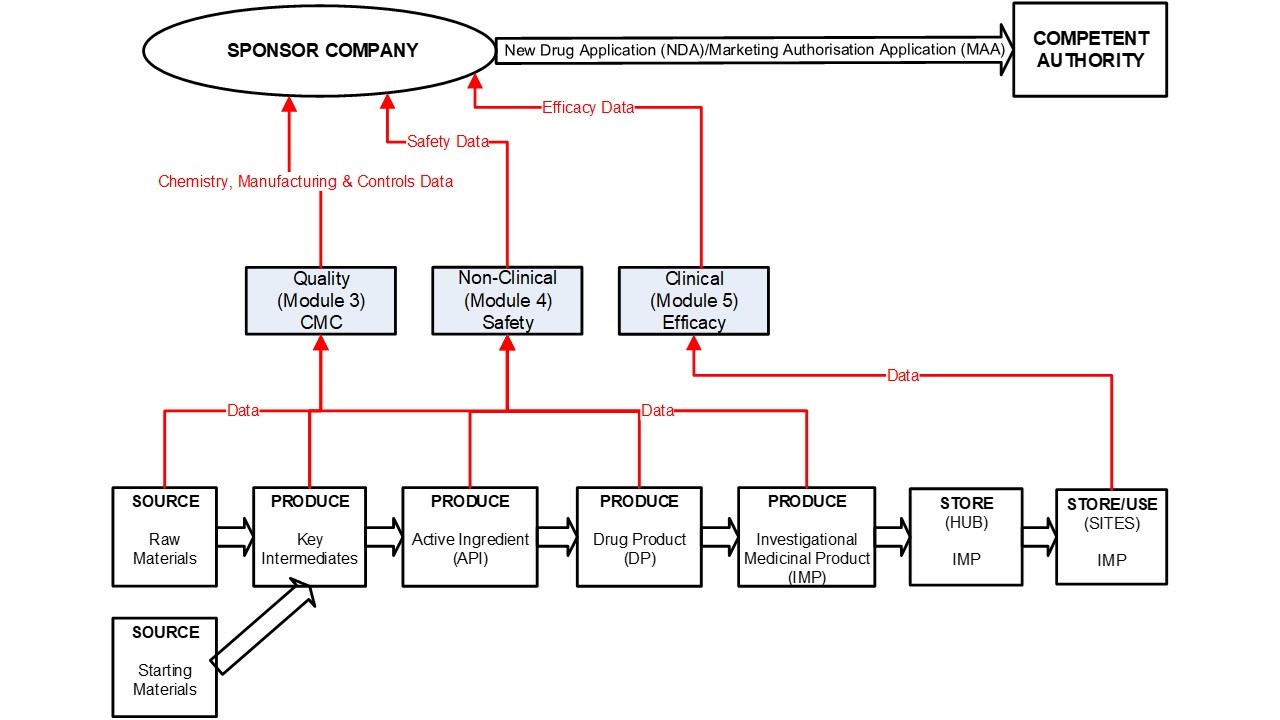
Figure 2: Clinical Supply-Chain
As previously, production of data (mainly clinical) is the primary focus, rather than preparedness of the supply-chain for the rigours of commercial supply. When the time comes to submit the regulatory filing (MAA/NDA/BLA), assuming clinical trials have gone to plan, the Competent Authority mandates the data be submitted using a common technical document (eCTD).
In Figure 2, Module 3: Quality, contains the CMC data, specifying the supply-chain in immense detail, not to be deviated from once approval is given. Some time prior to launch, attention turns to the supply-chain and the commercial team is invited on board. Guess what?
Have you guessed it? If not, this is it. There is a plethora of issues locked-in that commercial would like to fix, such as capacity limitations, supplier/service provider quality concerns, overly complex/convoluted supply routes, and others reader may like to contribute themselves.
The changes cannot be made of course due to time constraints, even if they were feasible to implement. The launch goes ahead ‘as is’.
The logistical complexity and widely devolved responsibility for supply-chain activities leaves those responsible for management of the beast in Figure 3 with a hopeless task. In focussing on data collection and regulatory submission through the development process, the principles of strategic supply-chain management have been omitted. It is as if the prime purpose of a supply-chain – to deliver fit-for-purpose products and services to customers – has been overlooked.
Yet the supply-chain must be managed in all respects by the marketing authorisation holder (MAH).
Figure 3 shows the key points of MAH responsibility and the complex nature of the commercial supply-chain that has evolved.
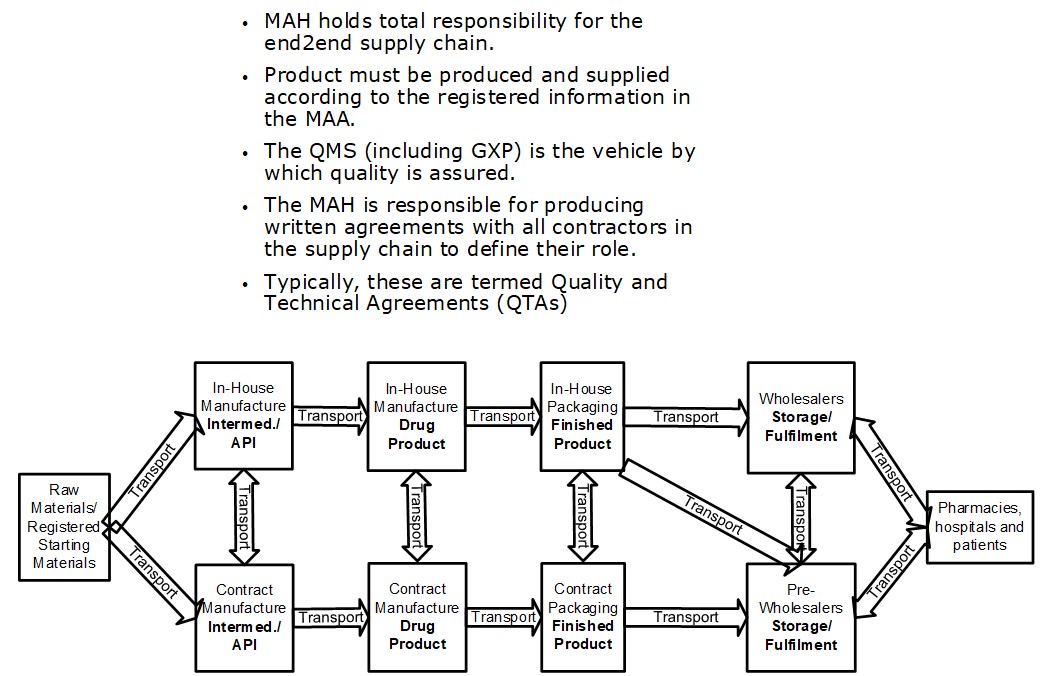
Figure 3: Today’s Commercial Supply-Chain
Hopefully, readers will appreciate from the above that the issues we see in the pharma supply chains of today have their seeds in product development, where little or no strategic supply-chain management methods and principles are applied.
So, is there light at the end of the tunnel?
In my opinion, the light will only shine through when companies developing medicines and healthcare products open their minds to a totally new model for product development – one that begins with its end-users – patients and healthcare professionals. A vital component part of that would be the adoption of strategic supply-chain management (SSM) from the inception of a development programme.
Returning finally to the subject of this article – supply-chain vulnerability exposed by COVID-19 – surely this ‘second call to action’ cannot be ignored in favour of the same old, or can it?
In part two of this article, we will explore how radical change can be facilitated though collaborative action of key stakeholders, including Competent Authorities.
[i] After Heparin: Protecting Consumers from the Risks of Substandard and Counterfeit Drugs, PEW Health Group
https://www.pewtrusts.org/-/media/legacy/uploadedfiles/wwwpewtrustsorg/reports/health/pewheparinfinalhrpdf.pdf
Author
Hedley Rees
Production Engineer, MBA
Managing Consultant at PharmaFlow Limited, UK
This article, “Is COVID-19 THE Long Overdue Wake-up Call for Pharma Supply-Chains?”, is reproduced from a recent issue of gmp review, a quarterly journal researched and edited by an expert team experienced in all aspects of pharmaceutical manufacturing and control.
Do you have any questions or suggestions? Please contact us at: redaktion@gmp-verlag.de

You may also be interested in the following articles:


