Skip to main content Skip to search Skip to main navigation

How are Quality Culture and a Symphony Orchestra Similar?

Translated excerpt from the 44th Episode of GMP & TEA, a German video series of GMP-Verlag

5 min. reading time | by Doris Borchert, PhD
Published in LOGFILE 15/2024

What do you associate with the word “culture”? 
It’s likely to be literature, fine art, or music, but not necessarily GMP. Yet, the term culture has found its place in our professional world in recent years, especially when it comes to quality. Today's editorial by Doris Borchert, PhD, highlights the striking connections between quality culture and a symphony orchestra.

When was the last time you went to a concert? What images have stuck? The conductor guiding his orchestra through the repertoire with grand gestures and high commitment? The first violin, connecting conductor and orchestra? Or the musicians working as a coordinated team, bringing the music to life? Either way, hopefully it was an amazing experience.Quality culture is like a symphony orchestra – the CEO is the conductor and quality management plays the first violin

A high-quality experience in a symphony orchestra relies on the perfect interplay of all participants. Even small discords can affect the overall artistic experience.

A very similar situation applies to GMP manufacturing: A standardised quality culture throughout the company is key to achieving a flawless quality result.

The following questions are addressed in detail:

  • What is quality culture?
  • What are the prerequisites to establish a strong quality culture?
  • What are the elements of a successful quality culture?

Quality Culture

The existence of a quality culture, its evaluation, and further development are referred to in various documents – especially those authored by the FDA. However, a clear definition of the term ‘quality culture’ is not yet anchored in the GMP regulations. While researching the definition of the term ‘quality culture’, I came across different variants. I preferred the following paraphrase:

‘Quality culture is a fusion of quality awareness and quality-orientated action.' The same text says: ‘Within an established quality culture, quality is unconsciously understood and implemented. Quality is not limited to the characteristics of a product or a process, but also includes people and the organisation in which they find themselves.’

Long before the term quality culture found its way into the GMP world, a paradigm shift in the way organisations deal with quality has already emerged:

From detecting real existing defects in the sense of quality control to preventing potential defects in the sense of quality assurance to proactive quality management. The introduction of quality culture concepts is a consistent continuation of this development.

This makes quality culture a cornerstone of successful pharmaceutical companies.


The Pre-requisites

Promoting a culture of quality is not a sure-fire success but involves a number of challenges.

The cornerstones of a sustainable solution are active quality management and a clear quality policy that sets the tone for the company's communication and strategic direction regarding quality.

Employees often complain that the quality policy is formulated too generally and is therefore not very meaningful. In fact, it is not easy to condense the content of the entire PQS into a few principles of a quality policy.

Concise formulations are therefore important. Abstract goals must be turned into concrete projects with clear tasks and responsibilities. And it goes without saying that the quality policy must be formulated in a credible manner. A company that has been cutting jobs for years and forgoing further training is not very convincing if it emphasises how important it is to promote and develop its employees.

Last but not least, well-functioning PQA processes must be implemented.

If we recall the image of a symphony orchestra, the conductor stands for active quality management, the score for the quality policy and the instrument groups embody the individual elements of the PQS.


The Elements

Each company must find its own way to establish a successful quality culture. However, there are some common principles which are briefly outlined below.


Quality First!

In practice, this means that business interests must not get in the way of consistently meeting quality requirements. Of course, it is important to avoid time pressure or delivery bottlenecks as far as possible, but the ability to deliver must never take precedence over quality.

Quality always comes first!


Personal Responsibility

Quality is not a question of individual people, such as the Quality Manager or the Qualified Person, nor of individual departments, such as Quality Assurance or Quality Control.

Quality is the responsibility of everyone!

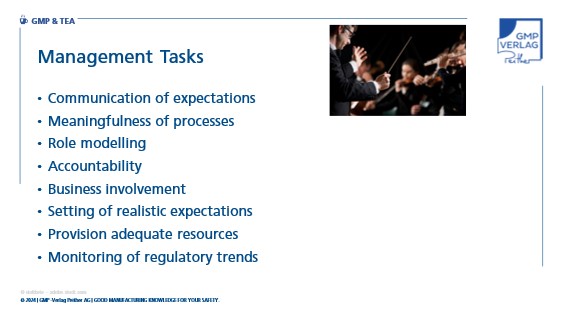
Therefore, quality awareness must be developed and maintained across all departments and hierarchies. This is especially the responsibility of the management. Quality culture starts at the top of the organisation and must be communicated and lived by the management.

Like a conductor, top management sets the pace and is responsible for ensuring that everyone internalises the desired quality culture.
The Organisation

In addition to management tasks, quality management plays a crucial role. Just as the first violin in an orchestra sets the tone, quality management ensures the structure, organisation and coordination of the individual instruments – excuse me: PQS elements – with each other.

Change and deviation management, CAPA, complaint handling, self-inspection and training all need to work together.

But just as it is not enough for everyone in a symphony orchestra to be able to play their own notes, the right interaction is also important here! This requires communication within the orchestra, but also coordination with the conductor, to stay with our metaphor.


The Culture of Error

Nobody is perfect. You have to allow yourself and others to make mistakes. Of crucial importance is the way you deal with mistakes. You need to be aware of the potential consequences of mistakes and be watchful enough to spot them.

Openness, trust and appreciation are important when dealing with colleagues, superiors and employees, especially so that mistakes are not concealed out of fear or shame. Transparent communication about errors, their causes and actions, as well as their significance, is the basis for quality awareness at all levels.

Open and good cooperation is therefore an important pillar of the quality culture. Under no circumstances should anyone be blamed or stigmatised for making a mistake. On the contrary, one should be rewarded for recognising a mistake and reacting correctly.


GMP & TEA is a popular GMP video series in German language.


Do you have any questions or suggestions? Please contact us at: redaktion@gmp-verlag.de

Dr. Doris Borchert
Dr. Doris Borchert

You may also be interested in the following articles:

News: EMA

EMA Clarifies Batch Numbering for Parallel-Traded Medicines

EMA updated its GMP/GDP Q&A collection by revising the answer to Question 4 concerning Chapter 5 of the EU GMP Guide. It explains which batch numbers should appear on the packaging of parallel-traded medicines.

Read more
Question of the Week | GMP-Verlag

Why is it Important to use Consistent Microbiological Air Monitoring Methods in Pharmaceutical Cleanrooms?

Here's the answer:
Read more
Cleaning Validation: When PDE Reports and the Worst-Case Selection do not Align

Cleaning Validation: When PDE Reports and the Worst-Case Selection do not Align

Robust PDE reports form the basis of risk-based cleaning validation. This article highlights common deficiencies identified during GMP inspections and explains how they can be avoided.

Read more
News: Europe

EDQM: New Working Party on 3D-printed Medicinal Products

The European Pharmacopoeia Commission (EPC) approved the creation of a working party on 3D-printed medicinal products. Its aim is to support the development of appropriate quality standards in the European Pharmacopoeia (Ph. Eur.).
Read more
EMA: 14 New Nitrosamines for Appendix 1

EMA: 14 New Nitrosamines for Appendix 1

Appendix 1 of EMA’s Questions and Answers on nitrosamine impurities has been updated. This appendix contains acceptable intakes (AIs) established for N-nitrosamines.
Read more
WHO: Draft Revision of its Guidelines on Quality Risk Management

WHO: Draft Revision of its Guidelines on Quality Risk Management

WHO published a revised draft of its “WHO guidelines on quality risk management”. Working document QAS/26.994 is open for public comment until 15 November 2026.
Read more
Previous
Next

Related Products

Skip product gallery
GMP Compliance Adviser | Named User Licence | 12M

GMP Compliance Adviser | Named User Licence | 12M

With an named user licence, one user can access the knowledge portal; with a corporate licence, any number of users can access it.Approx. 5,000 pages of practical GMP knowledge with illustrations and forms: Practical guidance for rapid implementation in the workplaceDetailed descriptions of GMP-compliant systemsInternational laws and guidelines Always up-to-date thanks to regular updates Download Advantages and Prices60+ Sample Documents In addition, the GMP Compliance Adviser contains more than 60 sample documents (MS Office) and practical examples that you can use.Sample SOPsSample FormsSample ReportsSample DocumentationChecklistsProcess Diagrams (Flowcharts)Practical Examples of QRM Application (e.g., Risk Analyses)Sample Documents for Qualification and ValidationCase StudiesWritten by more than 80 authors with hands-on experience directly linked to the industryA team of over 80 experts interpret regulatory requirements and describe how they are implemented in practice.The authors are experienced in the pharmaceutical industry, consulting, and government agencies.

delivery immediately after receipt of payment
€1,368.00 net excl. VAT
GMP:KnowHow Pharma Logistics (GDP) | Named User Licence | 12M

GMP:KnowHow Pharma Logistics (GDP) | Named User Licence | 12M

Your knowledge portal for GDP-compliant pharmaceutical logistics.  It is important that you as a logistics service provider, but also as a client in the pharmaceutical industry, comply with regulatory requirements. The GMP:KnowHow knowledge portal guides you through the complex regulatory landscape of the pharmaceutical and logistical supply chain! The knowledge portal gives you an easy-to-understand overview of all the important topics. Interactive graphics help you navigate all areas covered by the EU GDP Guidelines (2013/C 343/01). You also have the relevant passages of the regulations directly at hand for each topic. This allows you to compare the requirements directly and saves valuable research time.One thing is certain: the knowledge portal answers your questions about the supply chain of medicinal products, active pharmaceutical ingredients and medical devices. You don't have to be an expert. Yet.You will find answers to your questions in the GMP:KnowHow Pharma Logistics (GDP). Where does GDP begin, where does GMP end? What does GDP-compliant mean? When do I also have to take GMP requirements into account? What permits do I need for certain activities? What requirements do I have to fulfil? What is the current legal basis? How am I covered? What authorizations do I have for my work, e.g. from my employer? Who is responsible — the client or the contractor? And many more What is the difference to the GMP Compliance Adviser? GMP:KnowHow Pharma Logistics (GDP) is a practical knowledge portal dedicated to Good Distribution Practice (GDP). It is a product that is independent of the GMP Compliance Adviser and concentrates on content that is essential for carriers of medicinal products, active pharmaceutical ingredients and medical devices as well as for logistics clients. The focus is on practical knowledge and how to apply it in your daily business. If necessary, the relevant regulations can be called up immediately alongside the practical knowledge, and you can see the relevant paragraphs at a glance. In addition, sample documents are available to help you make immediate progress. AuthorSimone Ferrante, currently Director Quality at Fisher Clinical Services, previously served as Head of Quality Control and Responsible Person (GDP) for the Grieshaber Group. She is also a long-standing author and GDP expert at GMP-Verlag.

delivery immediately after receipt of payment
€610.00 net excl. VAT
E-Learning GMP:READY | Specialist Knowledge GMP for Engineers

E-Learning GMP:READY | Specialist Knowledge GMP for Engineers

Why are GMP rules important for technicians and engineers? Technicians and engineers play a key role in ensuring compliance with Good Manufacturing Practice (GMP) standards. They are involved in critical activities such as: planning and construction of ventilation systems, maintenance of water treatment plants, calibration of measuring sensors. Therefore, they are jointly responsible for the quality of medicines and must ensure that their work complies with GMP standards.Your advantages: Fast familiarization with GMP topics in approx. 2 hours, time- and location-independent online training, printable personal certificate, 12-month access for initial and follow-up training, automatic updates in case of legal changes,content compliant with Article 7(4) of Directive 2003/94/EC.The Author This e-learning course was developed with the collaboration of Dipl.-Ing. Andreas Nuhn (D & B Pharmadesign GmbH).

delivery time appr. 2-5 workdays after receipt of payment
€245.00 net excl. VAT
GMP Fundamentals | A Step-by-Step Guide

GMP Fundamentals | A Step-by-Step Guide

This handbook is a practical and easy to read guideline, giving you a quick and comprehensive overview of the complex world of Good Manufacturing Practice (GMP) without the need of previously acquired knowledge. Some topics are: GMP: Purpose and basic pharmaceutical terms Laws, licenses and inspections Personnel: Responsibility and hygiene Standard Operating Procedures (SOP) and documentation Design of rooms and facilities Processing and packaging Quality control and market release Suppliers, storage and logistics (Good Distribution Practice = GDP) Alphabetical index and abbreviations Using practical examples and comparisons to every-day life will help to easy understand GMP regulations.GMP Fundamentals is a helpful guide which facilitates the entry into the GMP world and teaches the necessary basics.

delivery immediately after receipt of payment
€44.90 net excl. VAT