Skip to main content Skip to search Skip to main navigation

Environmental Monitoring for Non-Sterile Manufacturing: Establishing Where to Sample

Excerpt from the PDA/DHI book Contamination Control in Healthcare Product Manufacturing, Volume 5

5 min. reading time | by Crystal Booth
Published in LOGFILE 36/2020

When selecting the number of sites to be sampled, the author recommends utilizing established guidelines. For example, ISO 14644-1:2015 contains a table used to establish the number of nonviable (total) particulate samples required based on the size of the room to be monitored.

As part of the environmental monitoring performance qualification (EMPQ), surface and active viable air samples are typically taken near the same locations as the nonviable particulate samples.

A common approach in establishing the monitoring sites includes obtaining a map of the room, gridding the room into equal sections, and using the risk assessment analysis results to choose the most appropriate locations to sample. The information obtained from the risk assessment is then used to plot out where in the grid the sample(s) should be taken. Samples should be collected at the sites identified to contain the highest risk of contamination.

Equipment surface monitoring sites should also be based on risk assessment and will change from company to company depending on the equipment and the products being manufactured (Sutton, 2009). Note that all risk assessment decisions should be documented.

Samples can be taken randomly within the grid section, at the same place each time within the grid section, evenly distributed within the grid sections, or the sample sites can be determined by risk assessment (Sandle, 2016). A documented risk assessment for the selection of the sample sites should be performed (PDA TR 13).

By using the risk assessment approach, one can base the samplesites on the following information:

  • Room layout (Sandle, 2016).
  • Equipment type (Sandle, 2016).
  • Airflow patterns (Sandle, 2016).
  • Position of air supply and return vents (Sandle, 2016).
  • Air-change rates (Sandle, 2016).
  • Room activities (Sandle, 2016).
  • The proximity to the exposed product (USP <1116>).
  • The proximity to the exposed containers (USP <1116>).
  • The proximity to the exposed closures (USP <1116>).
  • Sites that demonstrate heaviest microbial proliferation (USP <1116>).
  • Sites that are difficult to clean (USP <1116>).
  • Sites that are difficult to set up (USP <1116>).
  • High traffic areas (USP <1116>).
  • Material and waste flow (USP <1116>).
  • Impact of interventions (USP <1116>).
  • Length of the process (USP <1116>).
  • Sites that might contribute to microbe dispersal (USP <1116>).
  • Product contact surfaces (USP <1116>).
  • Proximity to utilities or drains.
  • Storage areas.
  • Spatial coverage.
  • Construction materials.
  • Potable water usage.

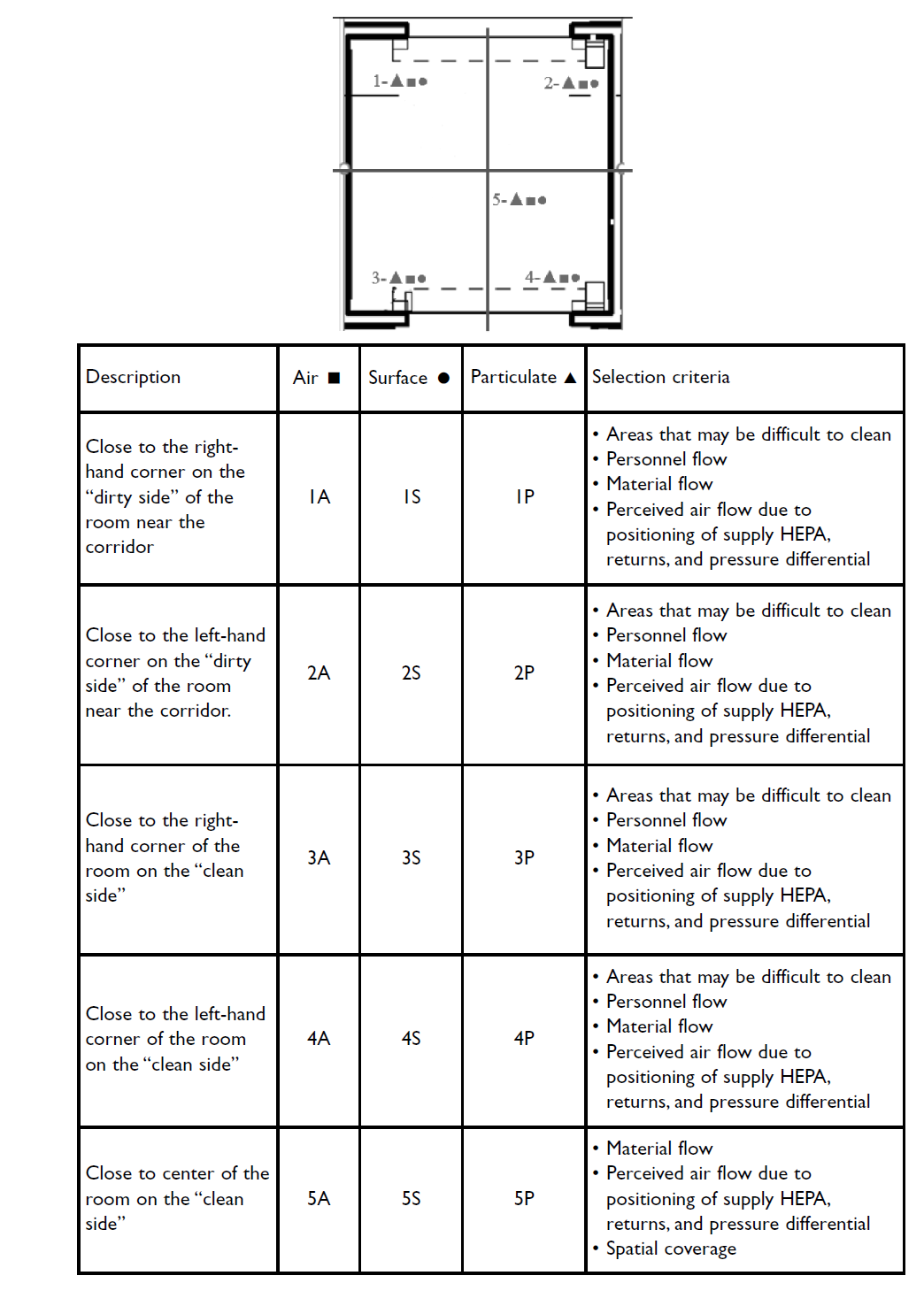
Sample sizes should be sufficient to optimize detection of environmental monitoring contaminants (FDA, 2004). Figure 1 demonstrates a room layout grid, which defines the sample locations to bemonitored during an EMPQ.

Figure 1 Sample Site Planning for EMPQ
References:

International Organization for Standardization (ISO) (2015) ISO 14644-1:2015(E) Cleanrooms and Associated Controlled Environments – Part 1: Classification of Air Cleanliness.

Parental Drug Association (PDA) (2014) PDA Technical Report No.13, Revised 2014: Fundamentals of an Environmental Monitoring Program. PDA, Bethesda, MD.

Food and Drug Administration (FDA) (2004) Guidance for Industry: Sterile Drug Products Produced by Aseptic Processing – Current Good Manufacturing Practice. Food and Drug Administration, Rockville, MD, USA.

Sandle, T. (2016) “ISO 14644 Parts 1 and 2 – The Revised Cleanroom Standard and Contamination Control.” In Madsen, R. and Moldenhauer, J. (eds.) Contamination Control in Healthcare Product Manufacturing PDA/DHI, pp. 3–32.

Sutton, S. (2009) Qualification of an Environmental Monitoring Program –
1 Selection/Justification of Sample Sites. PMF Newsletter August.

United States Pharmacopeia (USP) <1116> Microbiological Evaluation of Cleanrooms and Other Controlled Environments.


Do you have any questions or suggestions? Please contact us at: redaktion@gmp-verlag.de

GMP-Verlag
GMP-Verlag

You may also be interested in the following articles:

Outsourced Activities in the GDP Environment Part II: Contractual Agreements

Outsourced Activities in the GDP Environment Part II: Contractual Agreements

When outsourcing GDP activities, there is a need for concrete delimitation of responsibilities between a client and a contractor. Read more about the goals and the contents of a quality agreement in the following excerpt from GMP:KnowHow Pharmalogistics (GDP).

Read more
Question of the Week | GMP-Verlag

What are the Benefits and Limitations of Passive Temperature-Controlled Containers for Drug Transport?

Here's the answer:
Read more
FDA: Adjustment of Nitrosamine Limits for Short-Term Use Medicines

FDA: Adjustment of Nitrosamine Limits for Short-Term Use Medicines

The FDA has updated its recommendations on Acceptable Intake (AI) limits for nitrosamine impurities. Under certain conditions, the Agency now accepts a Less-Than-Lifetime (LTL) adjustment of AI limits for medicinal products that are not intended for lifetime use. This also represents an alignment with the LTL concept of ICH M7(R2).
Read more
Swissmedic: SMS Registration Becomes Prerequisite for GMP Certificates

Swissmedic: SMS Registration Becomes Prerequisite for GMP Certificates

As of 15 November 2026, active substances must be registered in the EMA's Substance Management Services (SMS) database before Swissmedic can include them in establishment licences and GMP certificates for active substance manufacturers. The new requirement results from modifications to the EudraGMDP database.
Read more
News: EMA

EMA: New Q&As for Biological Medicinal Products

The EMA has added a new section to its Q&As on biological medicinal products addressing medicinal products containing secretomes or extracellular vesicles (EVs) obtained from human or animal cells.
Read more
News: Europe

EU: Council Adopts the Pharmaceutical Package

On 28 September 2026, the Council of the European Union adopted the EU pharmaceutical package, marking another important step in the legislative process for the comprehensive reform of EU pharmaceutical legislation.
Read more
Previous
Next

Related Products

Skip product gallery
GMP Compliance Adviser | Named User Licence | 12M

GMP Compliance Adviser | Named User Licence | 12M

With an named user licence, one user can access the knowledge portal; with a corporate licence, any number of users can access it.Approx. 5,000 pages of practical GMP knowledge with illustrations and forms: Practical guidance for rapid implementation in the workplaceDetailed descriptions of GMP-compliant systemsInternational laws and guidelines Always up-to-date thanks to regular updates Download Advantages and Prices60+ Sample Documents In addition, the GMP Compliance Adviser contains more than 60 sample documents (MS Office) and practical examples that you can use.Sample SOPsSample FormsSample ReportsSample DocumentationChecklistsProcess Diagrams (Flowcharts)Practical Examples of QRM Application (e.g., Risk Analyses)Sample Documents for Qualification and ValidationCase StudiesWritten by more than 80 authors with hands-on experience directly linked to the industryA team of over 80 experts interpret regulatory requirements and describe how they are implemented in practice.The authors are experienced in the pharmaceutical industry, consulting, and government agencies.

delivery immediately after receipt of payment
€1,368.00 net excl. VAT
GMP:KnowHow Pharma Logistics (GDP) | Named User Licence | 12M

GMP:KnowHow Pharma Logistics (GDP) | Named User Licence | 12M

Your knowledge portal for GDP-compliant pharmaceutical logistics.  It is important that you as a logistics service provider, but also as a client in the pharmaceutical industry, comply with regulatory requirements. The GMP:KnowHow knowledge portal guides you through the complex regulatory landscape of the pharmaceutical and logistical supply chain! The knowledge portal gives you an easy-to-understand overview of all the important topics. Interactive graphics help you navigate all areas covered by the EU GDP Guidelines (2013/C 343/01). You also have the relevant passages of the regulations directly at hand for each topic. This allows you to compare the requirements directly and saves valuable research time.One thing is certain: the knowledge portal answers your questions about the supply chain of medicinal products, active pharmaceutical ingredients and medical devices. You don't have to be an expert. Yet.You will find answers to your questions in the GMP:KnowHow Pharma Logistics (GDP). Where does GDP begin, where does GMP end? What does GDP-compliant mean? When do I also have to take GMP requirements into account? What permits do I need for certain activities? What requirements do I have to fulfil? What is the current legal basis? How am I covered? What authorizations do I have for my work, e.g. from my employer? Who is responsible — the client or the contractor? And many more What is the difference to the GMP Compliance Adviser? GMP:KnowHow Pharma Logistics (GDP) is a practical knowledge portal dedicated to Good Distribution Practice (GDP). It is a product that is independent of the GMP Compliance Adviser and concentrates on content that is essential for carriers of medicinal products, active pharmaceutical ingredients and medical devices as well as for logistics clients. The focus is on practical knowledge and how to apply it in your daily business. If necessary, the relevant regulations can be called up immediately alongside the practical knowledge, and you can see the relevant paragraphs at a glance. In addition, sample documents are available to help you make immediate progress. AuthorSimone Ferrante, currently Director Quality at Fisher Clinical Services, previously served as Head of Quality Control and Responsible Person (GDP) for the Grieshaber Group. She is also a long-standing author and GDP expert at GMP-Verlag.

delivery immediately after receipt of payment
€610.00 net excl. VAT
E-Learning GMP:READY | Specialist Knowledge GMP for Engineers

E-Learning GMP:READY | Specialist Knowledge GMP for Engineers

Why are GMP rules important for technicians and engineers? Technicians and engineers play a key role in ensuring compliance with Good Manufacturing Practice (GMP) standards. They are involved in critical activities such as: planning and construction of ventilation systems, maintenance of water treatment plants, calibration of measuring sensors. Therefore, they are jointly responsible for the quality of medicines and must ensure that their work complies with GMP standards.Your advantages: Fast familiarization with GMP topics in approx. 2 hours, time- and location-independent online training, printable personal certificate, 12-month access for initial and follow-up training, automatic updates in case of legal changes,content compliant with Article 7(4) of Directive 2003/94/EC.The Author This e-learning course was developed with the collaboration of Dipl.-Ing. Andreas Nuhn (D & B Pharmadesign GmbH).

delivery time appr. 2-5 workdays after receipt of payment
€245.00 net excl. VAT
GMP Fundamentals | A Step-by-Step Guide

GMP Fundamentals | A Step-by-Step Guide

This handbook is a practical and easy to read guideline, giving you a quick and comprehensive overview of the complex world of Good Manufacturing Practice (GMP) without the need of previously acquired knowledge. Some topics are: GMP: Purpose and basic pharmaceutical terms Laws, licenses and inspections Personnel: Responsibility and hygiene Standard Operating Procedures (SOP) and documentation Design of rooms and facilities Processing and packaging Quality control and market release Suppliers, storage and logistics (Good Distribution Practice = GDP) Alphabetical index and abbreviations Using practical examples and comparisons to every-day life will help to easy understand GMP regulations.GMP Fundamentals is a helpful guide which facilitates the entry into the GMP world and teaches the necessary basics.

delivery immediately after receipt of payment
€44.90 net excl. VAT