Skip to main content Skip to search Skip to main navigation

EFPIA: Results of the Member Survey 2025 on GMP and GDP Inspections

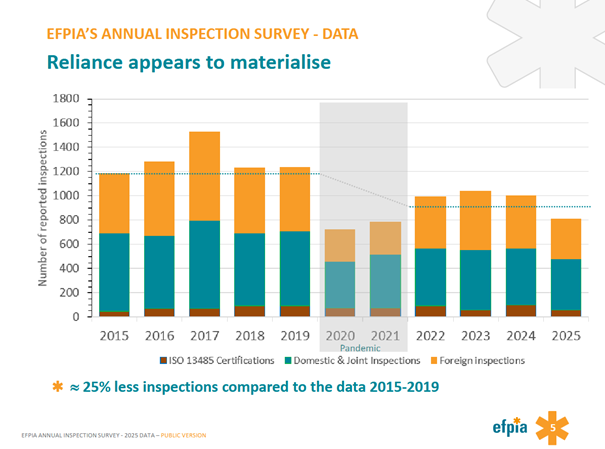
The European Federation of Pharmaceutical Industries and Associations (EFPIA) has published the results of its “Annual Regulatory GMP/GDP Inspection Survey 2025”. The data suggest that international GMP inspections are increasingly being replaced by reliance and work-sharing approaches between inspectorates.

According to EFPIA, the number of reported inspections decreased by approximately 25% compared with the 2015–2019 period. The industry interprets this as a possible indication that authorities are increasingly relying on inspections performed by other inspectorates and reducing duplication.

The survey particularly highlights that:

  • foreign inspections are decreasing overall,
  • reliance approaches among PIC/S authorities are advancing,
  • on-site inspections remain the standard,
  • remote inspections are only a backup option,
  • document-only inspections are declining significantly,
  • inspections are becoming more risk-based and system-focused.

EFPIA also reports that implementation of the revised Annex 1 has not led to an increase in inspections at sterile manufacturing sites. In addition, announced and unannounced inspections reportedly showed similar outcomes.

Further trends identified in the survey include:

  • stronger inter-agency coordination,
  • coordinated or joint inspections,
  • harmonised inspection report formats,
  • and digital collaboration platforms for information exchange between authorities.

EFPIA calls on authorities to make broader use of existing reliance tools, particularly PIC/S mechanisms and Mutual Recognition Agreements (MRAs), and to further pursue the vision of “one inspection per site”.

Source:

EFPIA: Annual Regulatory GMP/GDP Inspection Survey 2025 data

Meet the GMP Compliance Adviser

The GMP Compliance Adviser is the world's largest knowledge portal for quality management in the pharma business. 

The demo access is non-binding and ends automatically.

Test it now for free

You may also be interested in the following articles:

Damage Control: Complaints and Recalls

Damage Control: Complaints and Recalls

Complaint handling and product recalls are important components of the Pharmaceutical Quality System (PQS). They serve to identify defective medicinal products and ensure that appropriate measures are taken to protect patient safety, as required by law and the competent supervisory authority.

Read more
What are the Phases of a Working Cycle During a Steam Sterilisation Process?

What are the Phases of a Working Cycle During a Steam Sterilisation Process?

Here's the answer:
Read more
EMA: 9 New Nitrosamines for Appendix 1

EMA: 9 New Nitrosamines for Appendix 1

Appendix 1 of EMA’s Questions and Answers on nitrosamine impurities has been updated. This appendix contains acceptable intakes (AIs) established for N-nitrosamines.
Read more
EMA: Reduced Testing of Incoming Starting Materials is a GMP Matter

EMA: Reduced Testing of Incoming Starting Materials is a GMP Matter

The European Medicines Agency (EMA) published an update to its “Quality of Medicines: Questions and Answers – Part 2”. The revision concerns the section on “Reduced testing of incoming starting materials”.
Read more
What Types of Impurities may be Present in Active Substances?

What Types of Impurities may be Present in Active Substances?


Read more
There’s Something in the Air – Cleanroom Technology in the Pharmaceutical Industry

There’s Something in the Air – Cleanroom Technology in the Pharmaceutical Industry

In pharmaceutical manufacturing, clean air is not a subjective perception but a precisely controlled technical condition that is essential for product safety. Heating, ventilation and air-conditioning (HVAC) systems ensure, through airflow management, air filtration and pressure control, that particles and microorganisms are kept away from critical areas. This is based on clearly defined requirements for air changes, cleanliness classes, airflow patterns and pressure concepts, all of which are designed according to the manufacturing process and contamination risk involved.
Read more
Previous
Next